There is a version of the AI for private equity conversation that is entirely future-tense. Predictions about what AI will do to deal sourcing, how it will transform portfolio monitoring, what happens when autonomous agents start making recommendations. That conversation is interesting, but it is also untethered from what is actually happening inside PE firms right now. This piece focuses on practical private equity ai within an integrated investment platform context, not speculative hype.
 |
The reality in 2026 is more specific and, in some ways, more useful to understand. AI is already being used in private equity. Not speculatively, not in pilot programs at a handful of firms, but in daily operational workflows at fund managers, deal teams, and investor relations functions of varying sizes. The applications that have actually taken hold are narrower than the futurist version suggests, and more consequential than the sceptical version allows. These gains are showing up across modern fund manager software and investment software for fund managers used in real, daily workflows.
This article covers what those applications are, where AI is genuinely changing how PE teams work, and what the firms seeing the most value have in common.
"The firms seeing the most value from AI are not using the most sophisticated tools. They are using AI on the most connected data."
Deal sourcing: from manual screening to signal-assisted origination
Deal sourcing is where AI for private equity has arguably had the most visible early impact, and also where the most overclaiming tends to happen. AI does not find deals. It helps deal teams process more signals faster, so the human judgment that decides which signals are worth following can be applied earlier and more selectively.
In practice, this looks like AI tools that score inbound opportunities against a defined mandate before a human analyst has reviewed them, surface companies matching a specific sector or growth profile from proprietary and third-party data sources, and flag changes in a target company's publicly available signals hiring patterns, product announcements, financing activity that might indicate a window of opportunity or a reason to engage. Firms often route these signals through a deal flow management platform or ai deal management workflow connected to an investment crm to maintain mandate fidelity without extra manual work.
The firms making this work effectively are not using AI as a replacement for origination judgment. They are using it to compress the time between a signal appearing and a decision-maker seeing it, and to ensure that their defined investment criteria are applied consistently across a larger volume of opportunities than a team could manually review.
Due diligence: document analysis at a scale humans cannot match
Due diligence is the application where AI for private equity is generating the clearest and most measurable time savings, especially when powered by due diligence software. A typical M&A or investment due diligence process involves reviewing hundreds of documents, financial statements, legal agreements, customer contracts, regulatory filings, much of which requires a trained eye to flag the relevant information but does not require senior judgment to read the first time.
AI tools applied to virtual data room document sets can extract key terms from contracts, identify clauses that deviate from standard templates, summarize management presentations, and flag financial anomalies in reported data tasks that currently consume significant analyst time and whose value is in the flagging, not in the reading itself. A senior investment professional reviewing an AI-generated summary of a 200-page credit agreement, with deviations highlighted, is making better use of their time than reading the same agreement from start to finish. These capabilities are increasingly embedded in fund manager software rather than standalone utilities.
The practical constraint is the same one that applies across all AI for private equity applications: this only works well when the document set is organized and the AI has access to the full data room rather than a manually assembled selection of files. A well-structured virtual data room connected to an AI-capable deal management platform (an example of an integrated investment platform) performs significantly better than AI tools applied to a disorganized document collection shared via email.
How connected deal management software changes the operational foundation that AI in private equity needs to deliver real value. Think of this as an integrated investment platform rather than disconnected point tools.
LP reporting: eliminating the production cycle
Quarterly LP reporting is consistently cited as one of the most time-consuming operational functions in private equity, and it is the application where AI is generating some of the clearest ROI right now. Not because AI is making investment decisions about portfolio companies, but because it is eliminating the manual production work that currently consumes weeks of analyst and investor relations team time every quarter.
The workflow that AI is replacing looks something like this: collect data from multiple fund administrator statements, reconcile inconsistencies, format into report templates, write commentary, review for accuracy, and distribute. Each of those steps is time-consuming. Most of them are also highly automatable once the underlying portfolio data is structured and connected. This is the essence of lp reporting automation.
AI-assisted reporting tools applied to connected portfolio data can generate first drafts of quarterly reports, including written commentary on portfolio company performance, in hours rather than weeks. The investment team then reviews, adjusts the commentary where their judgment differs from the AI-generated version, and distributes. The human role shifts from production to editorial, which is where professional judgment actually adds value.
Investor relationship management: engagement signals at scale
Managing LP relationships in a PE firm with a large investor base means tracking dozens or hundreds of individual conversations, commitments, document access events, and interest signals across multiple funds simultaneously. The manual version of this requires a disciplined team maintaining an investment CRM that is only as good as how consistently it is updated after every interaction.
AI applied to investor relationship management works differently. Rather than relying on manual CRM updates, it captures engagement signals automatically which LPs accessed the ai investor portal this week, which documents they spent time on, which follow-up communications have gone unanswered for longer than expected and surfaces these signals to the relationship manager without them having to check each one individually.
The result is that a relationship manager covering 80 LPs can maintain the same quality of individual relationship attention that would previously have required a significantly larger team, because the AI is handling the monitoring and signal detection while the human handles the response and relationship judgment. These same signals can also support ai fundraising by highlighting LP interest trends ahead of new vehicles.
What the firms seeing the most value have in common
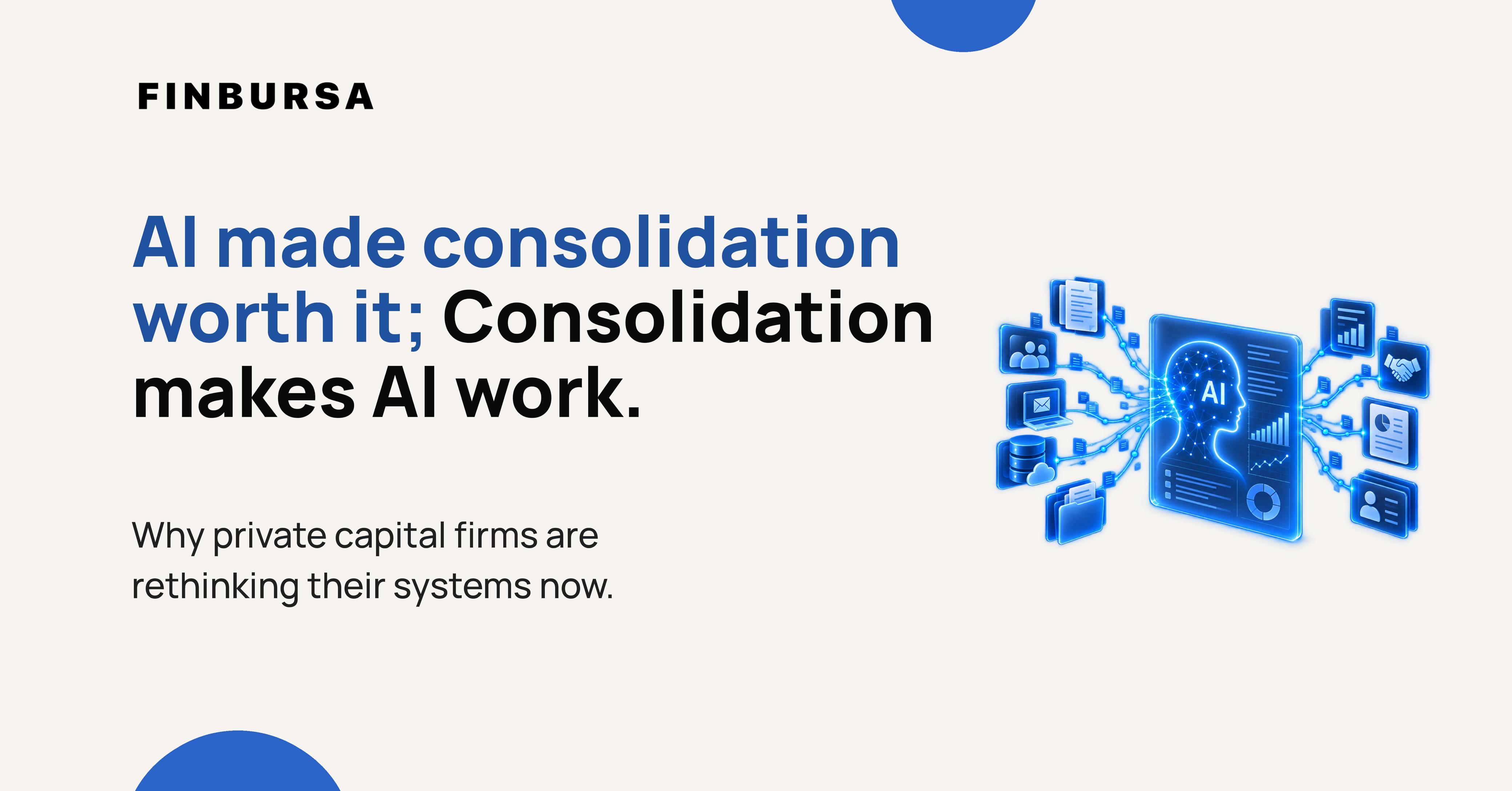
Across deal sourcing, due diligence, LP reporting, and investor relationship management, the PE firms getting the most from AI share one characteristic that is more predictive of success than the sophistication of any individual tool: their data is connected.
AI for private equity does not perform well on fragmented data. A deal management system that is separate from the VDR, which is separate from the investor CRM, which is separate from the LP portal, produces data that is incomplete by the time any AI tool tries to draw insight from it. The AI can only see what is in front of it, and if what is in front of it is one piece of a disconnected picture, the output reflects that limitation. That means connecting ai deal management, due diligence software, an investment crm, and the ai investor portal within an integrated investment platform or ai investment software for fund manager. More broadly, investment software for fund managers that unifies these datasets raises the baseline for every subsequent AI use case.
The firms that have invested in connecting their deal management, investor CRM, VDR, and portfolio data into a single platform are not doing this primarily to enable AI. They are doing it because connected data makes every operational decision better. The AI capability is a direct consequence of that infrastructure decision, not a separate initiative on top of it.
What AI is not doing in private equity and why that matters
As important as what AI is doing in private equity right now is what it is not doing, because the misconceptions in this direction are as costly as the overclaiming in the other.
AI is not making investment decisions. It is not identifying which company to acquire or which fund to back. The judgment required for those decisions understanding management quality, assessing competitive dynamics, forming a view on valuation is not something current AI systems do reliably, and PE firms that are performing well are not asking them to.
AI is not replacing the relationship dimension of private equity. Deal sourcing still happens through trusted networks. LP relationships still depend on personal credibility and consistent follow-through. The AI is surfacing signals that help humans act on these relationships more precisely and at greater scale. It is not a substitute for the relationship itself.
And AI is not a shortcut past the need for good data. Firms that invest in AI tools before investing in data infrastructure consistently report disappointing results not because the AI is poor, but because the data it is operating on is incomplete. The infrastructure decision comes first. The AI capability follows.
Conclusion
The most useful frame for AI in private equity right now is not transformation but amplification. AI is making experienced deal teams faster at the parts of their work that are high volume and low judgment, so they can spend more time on the parts that are low volume and high judgment. That is a meaningful operational shift, even if it is less dramatic than the version where AI autonomously identifies the next great investment.
The firms that are ahead on this are not necessarily the largest or the most technically sophisticated. They are the ones that recognized early that AI capability in private equity is a function of data infrastructure, invested in connecting their deal and investor data accordingly, and are now reaping the compounding benefit of that decision across every new tool and capability they add on top of it.
That infrastructure gap is still wide enough that building it now creates a real operational advantage over peers who are still deciding whether to start.
FAQs
How are private equity firms using AI today?
Private equity firms are currently using AI in four main operational areas: deal sourcing, where AI screens opportunities against a defined mandate and surfaces relevant signals; due diligence, where AI extracts key terms, flags contract deviations, and summarizes documents; LP reporting, where AI generates first drafts of quarterly reports from connected portfolio data; and investor relationship management, where AI captures LP engagement signals automatically from portal and VDR activity. Many firms orchestrate this through an integrated investment platform combining an investment CRM, a deal flow management platform, and a virtual data room.
What does AI for private equity actually do in due diligence?
AI for private equity in due diligence, often delivered through due diligence software, extracts key terms and clauses from legal documents, identifies deviations from standard contract templates, summarizes management presentations and information memoranda, and flags anomalies in financial data. This reduces the volume of manual document review required from senior investment professionals, allowing their time to be focused on interpretation and judgment rather than initial document processing.
Can AI replace investment judgment in private equity?
No. AI does not make investment decisions in private equity and is not being used to do so by firms that are performing well. The judgment required to evaluate management quality, assess competitive dynamics, and form a view on valuation is not something current AI systems perform reliably. AI in private equity is applied to operational tasks — document processing, data monitoring, report generation, signal detection — where automation produces time savings without requiring the AI to exercise professional judgment.
Why does connected data matter so much for AI in private equity?
AI investment software for private equity produces more accurate and useful output when it operates on a connected data model spanning deal management, VDR, investor CRM, and portfolio data, because it has access to the full picture of a deal or relationship rather than a fragment of it. AI applied to fragmented data in separate tools produces incomplete output, since it can only draw insight from what it can see. Firms that invest in connecting their data before deploying AI tools consistently outperform those that add AI tools to a fragmented data infrastructure.
What is the ROI of AI for private equity firms?
The clearest ROI from AI for private equity is in LP reporting, where LP reporting automation and AI-assisted tools can reduce quarterly report production time by up to 60%, and in due diligence document review, where AI processing can reduce initial document review time by approximately 40%. Deal sourcing ROI is harder to quantify directly but shows up as increased coverage — more opportunities screened against a consistent mandate — rather than higher conversion rates on individual opportunities. Investor relationship management ROI shows up as team scalability, with relationship managers covering larger LP bases without proportional headcount growth.
Disclaimer: The content in this article is provided for general informational purposes only and does not constitute financial, investment, legal, or professional advice. While artificial intelligence can support data analysis and decision-making, AI systems can produce errors, biased outputs, or incomplete information, and should not be relied upon as the sole basis for any investment decision. This article does not endorse or guarantee the accuracy, reliability, or suitability of any AI tool, model, or methodology discussed. Readers should perform their own independent research and consult with qualified financial, legal, and investment professionals before making any investment or business decisions.