Investment software means different things depending on who is asking. A venture capital fund manager evaluating tools is thinking about deal flow and portfolio company monitoring. A family office is thinking about consolidating positions across ten different funds. An accelerator is thinking about tracking a cohort of portfolio companies through multiple funding rounds. An advisory firm is thinking about running parallel M&A mandates without losing track of any single deal.
 |
What unites all of these use cases is a common underlying problem: portfolio and deal information that should inform every decision is scattered across spreadsheets, email, and disconnected tools, and the manual work required to assemble a complete picture before acting consumes time that should be spent on analysis and judgment instead.
This article walks through how investment software, including AI-enabled investment software, improves portfolio outcomes for each of these segments specifically, what to look for when evaluating asset management technology, and why the connection between tools matters more than any individual feature.
"Investment software does not replace judgment. It removes the friction that currently sits between information and the decisions that depend on it."How investment software improves portfolio outcomes, by segment
The specific software and capabilities that move the needle differ meaningfully by who is using them. The following breakdown maps the most relevant categories of investment software to the segment that benefits most from each.
Segment 01 — Fund Managers
For fund managers, the most direct portfolio improvement comes from AI deal management applied to a connected pipeline. AI investment software for fund manager use cases can match opportunities to mandate fit, surface engagement signals from investor and VDR activity, and forecast which deals are most likely to progress. This requires investment software for fund managers that holds deal flow, investor CRM, and document engagement in a single connected data model rather than separate tools.
Segment 02 — Family Offices
For family offices managing positions across multiple funds and direct investments, asset management software consolidates the full portfolio into one view with real-time data instead of quarterly lag. AI investment software for family office use cases can summarise fund reports, flag anomalies in reported performance, and support faster co-investment evaluation by surfacing how a new opportunity fits against existing exposure.
Segment 03 — Venture Capital
For venture capital firms, investment software for venture capital combines portfolio company monitoring with deal sourcing and market research. AI investment software for venture capital applications include synthesising market research across a sector, tracking portfolio company KPIs against fund benchmarks, and surfacing follow-on investment opportunities based on portfolio company performance signals.
Segment 04 — Accelerators
For accelerators managing a cohort of portfolio companies simultaneously, investment software for accelerators needs to track multiple companies through structured programme stages, monitor progress against milestones, and manage investor introductions for graduating companies. AI investment software for accelerators can help identify which portfolio companies are showing the strongest traction signals and which require additional support before a fundraising introduction.
Segment 05 — Investment Advisory Firms
For investment advisory firms running parallel M&A or capital raising mandates, investment software for advisory firms needs to manage multiple simultaneous deal processes without cross-contamination of confidential information, while maintaining full audit trails for each mandate. AI investment software for investment advisory firms supports this by surfacing buyer or investor engagement signals specific to each mandate and flagging deals at risk of stalling.
Segment 06 — Fundraising and Investor Relations
Across every segment above, AI fundraising tools and an AI investor portal improve the investor-facing side of portfolio management. An AI investor portal can surface which investors are actively engaged with deal materials, recommend optimal follow-up timing, and reduce the manual administration of investor communication. AI deal management applied consistently across fundraising and existing portfolio relationships creates a compounding advantage that improves with every additional deal cycle.
Why AI deal management depends on connected data
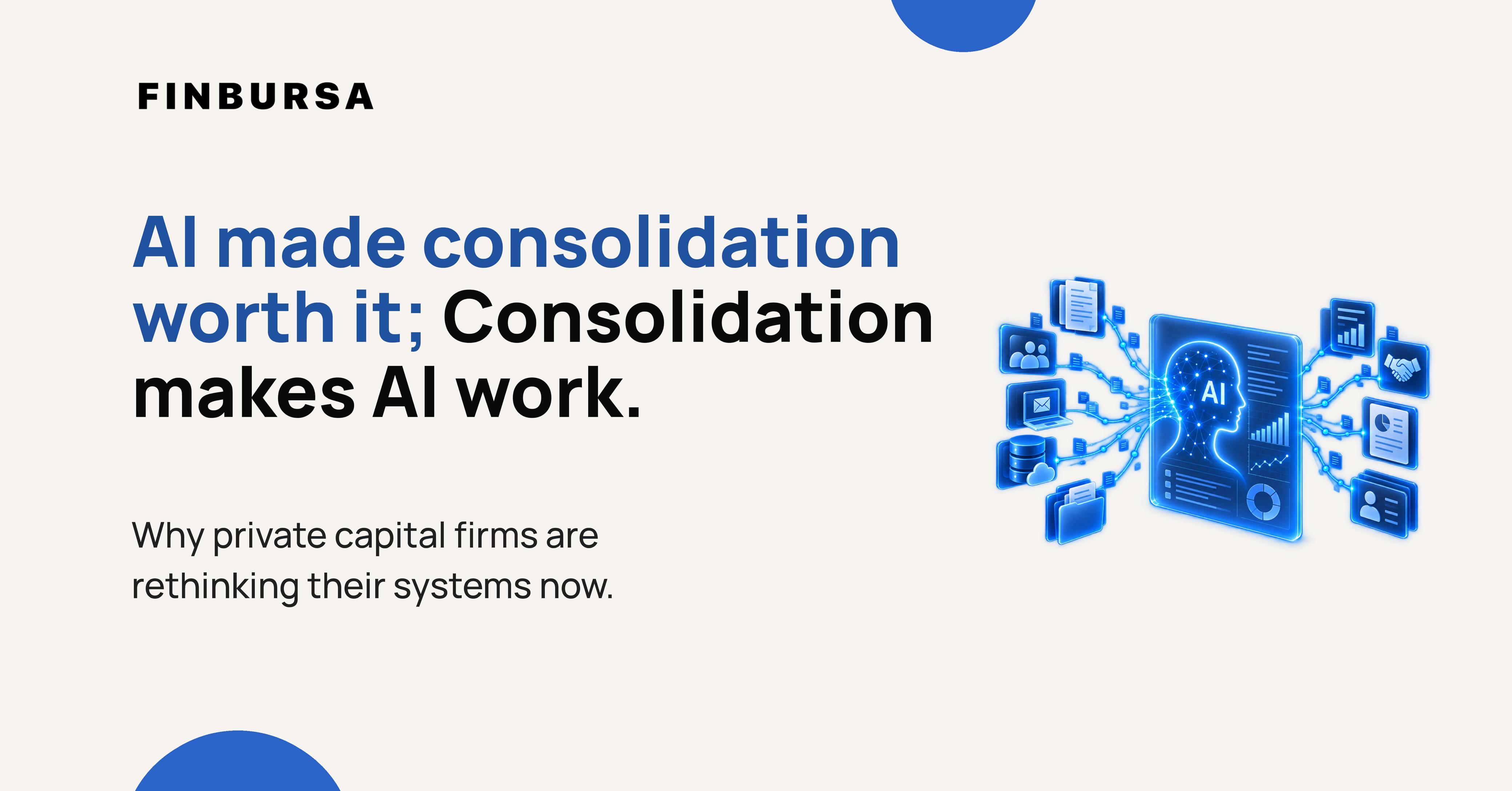
Across every segment, the AI capabilities that genuinely improve portfolio outcomes depend on one underlying requirement: connected data. AI deal management, AI fundraising, and an AI investor portal can only surface meaningful signals when the underlying deal, investor, and document data share a common data model. Applied to a single fragmented data source, AI produces limited insight regardless of how sophisticated the AI model itself is.
As we explored in our analysis of how AI is transforming insights and returns in private equity, the value of AI in investment management scales directly with the quality of the data infrastructure beneath it. This is true whether the AI is being applied to deal management for a fund manager, portfolio monitoring for an accelerator, or investor engagement analysis for an advisory firm.
Related reading on FinBursa AI for Private Equity: Transforming Insights and Returns How AI is changing deal sourcing, due diligence, and portfolio monitoring in private equity, and why connected data is the prerequisite for meaningful AI capability.
What good deal management software actually delivers
For fund managers and advisory firms specifically, the core of any investment software evaluation is the deal management function. Strong deal management software tracks every opportunity through customisable pipeline stages, connects to investor relationship data, and integrates with the virtual data room used for due diligence — rather than treating each of these as a separate purchase.
As we examined in our breakdown of the benefits of private equity deal management software, the operational gains from a properly integrated deal management platform extend well beyond pipeline visibility, into deal velocity, investor relationship quality, and the AI readiness that depends on having all of this data in one place.
Related reading on FinBursa Benefits of Private Equity Deal Management Software The specific operational and financial benefits that connected deal management software delivers for private equity firms managing active deal flow.
Signs your portfolio would benefit from better investment software
- Your team uses different tools for deal tracking, investor relationships, and document management with no connection between them.
- Market research and competitive analysis are conducted manually for every new opportunity rather than informed by accumulated portfolio data.
- Evaluating a new investment requires reconstructing your current exposure or portfolio company performance from memory or scattered files.
- AI tools you have evaluated for deal or portfolio analysis were rejected because the underlying data was too fragmented to use effectively.
- Investor or LP follow-up is based on calendar reminders rather than engagement signals from your VDR or investor portal.
- Portfolio company or fund-level reporting takes days or weeks to assemble rather than being available in a connected, real-time view.
- A single team member leaving would create a meaningful gap in institutional knowledge about your portfolio or deal pipeline.
Conclusion
Investment software does not improve a portfolio by replacing the judgment of the people managing it. It improves the portfolio by removing the structural friction between the information decision-makers need and the time it currently takes to assemble it. Whether that decision-maker is a venture capital partner evaluating a follow-on round, a family office principal assessing a co-investment, or an advisory firm partner managing three simultaneous mandates, the underlying improvement is the same: faster access to complete, connected information.
The specific tools differ by segment. The principle does not. AI deal management, AI fundraising, and an AI investor portal all depend on the same prerequisite: a connected data model rather than a fragmented stack of disconnected point solutions. Firms that get this right gain a compounding advantage across every subsequent deal, fundraise, and portfolio decision.
The question worth asking is not whether investment software would help a given portfolio. For any fund manager, family office, accelerator, venture capital firm, or advisory firm managing meaningful deal flow or assets, it almost certainly would. The question is whether the software being evaluated actually connects the data, or simply digitises the fragmentation that already exists.
FAQs
How can investment software improve my portfolio?
Investment software improves a portfolio by consolidating deal flow, investor relationships, portfolio company or fund data, and market research into one connected system, replacing manual spreadsheet aggregation with real-time visibility. When combined with AI investment software, it can surface engagement signals, match opportunities to mandate fit, and flag risks or opportunities that a manual process would likely miss. The improvement is proportional to how connected the underlying data is across the platform.
What is the best investment software for fund managers and venture capital firms?
The best investment software for fund managers and venture capital firms natively integrates AI deal management, investor CRM, virtual data room, fundraising campaign tools, and portfolio company monitoring in a single connected platform. AI investment software for venture capital specifically should support market research synthesis, portfolio company KPI tracking, and follow-on investment signal detection, all sharing the same data model as deal flow and investor relationship management.
What should family offices and accelerators look for in asset management software?
Family offices should look for asset management software that consolidates fund positions, direct investments, and co-investments into one real-time view with AI investment software capability for report summarisation and anomaly detection. Accelerators should look for investment software for accelerators that tracks a portfolio company cohort through structured programme stages, monitors milestone progress, and supports investor introduction workflows for graduating companies. Both segments benefit most when the underlying data model is connected rather than fragmented.
How does AI deal management work in investment software?
AI deal management in investment software works by applying AI models to connected deal pipeline, investor relationship, and document engagement data to surface signals that inform decision-making: which opportunities match investor or fund appetite, which deals show engagement patterns indicating likely progression, and which require attention because activity has stalled. AI deal management is only effective when applied to a connected data model; applied to fragmented data across separate tools, it produces limited or unreliable output.
What investment software features matter most for advisory firms running multiple mandates?
Investment software for advisory firms running multiple mandates should provide isolated, secure deal workspaces for each transaction, native virtual data room integration with audit trails specific to each mandate, AI investment software for investment advisory firms capability to surface buyer or investor engagement signals per deal, and centralised oversight that allows partners to monitor all active mandates without compromising confidentiality between them.
How does an AI investor portal improve fundraising outcomes?
An AI investor portal improves fundraising outcomes by capturing every investor interaction — document access, time spent reviewing materials, questions submitted — as a live signal connected to the investor relationship record. AI fundraising tools applied to this data can recommend optimal follow-up timing, identify which investors are most engaged, and flag investors whose engagement pattern suggests they have disengaged from the process, enabling faster and more targeted fundraising follow-up than calendar-based outreach.