There is a gap that rarely gets discussed in private markets conversations. It is not a gap in deal quality, investor appetite, or available capital. It is a gap in operational intelligence — the difference between how much information private market professionals need to manage their portfolios effectively and how much their current infrastructure actually delivers.
 |
Private markets grew up in an era before connected data infrastructure existed at scale. The operational model reflects that history. Fund managers, family offices, and wealth managers have long accepted quarterly PDF reports, manual data aggregation, and fragmented technology as simply the way this asset class works.
That acceptance is becoming harder to justify as allocations grow, investor expectations rise, and the tools to do things differently become increasingly accessible.
A Growing Asset Class With Aging Infrastructure
The scale of private markets is no longer niche. Global private credit AUM crossed $2 trillion in 2025 according to the Alternative Credit Council, up from $1.7 trillion in 2024 — and Moody's projects it will approach $4 trillion by 2030. Private equity deal value increased 19% in 2025 to $2.6 trillion, with global buyout deal value reaching nearly $1.8 trillion — the second-highest year on record, according to McKinsey's Global Private Markets Report 2026.
According to BlackRock's 2026 Private Markets Outlook, private markets are moving from niche allocations to essential components of resilient portfolios — with private credit, infrastructure, and private equity all seeing expanding demand from both institutional and wealth channel investors.
Yet the operational infrastructure managing much of this capital has not kept pace. A 2024 Deloitte survey of 354 single-family offices globally found that nearly three-quarters — 72% — admit they are either underinvested or only moderately invested in the operational technology needed to run a modern business. When asked about their primary operational risks, respondents most frequently cited manual processes and over-reliance on spreadsheets. Their most sought-after technologies were automated investment reporting systems and wealth aggregation platforms — according to the RBC and Campden Wealth North America Family Office Report 2025.
That gap between AUM and operational sophistication is the defining tension in private markets right now.
What a Typical Quarterly Cycle Actually Looks Like
Consider a fund manager running a mid-market private equity fund with 80 limited partners.
The fund administrator calculates NAV. That process takes several weeks. The output is a capital account statement — one per LP — produced in a format that varies by administrator. The fund manager's investor relations team collects those statements, extracts data manually, formats a quarterly report, adds written commentary, and distributes by email. By the time an LP receives their report, the data it contains may be ten to twelve weeks old.
Now consider a family office holding positions in ten different funds simultaneously — each with a different administrator, a different reporting format, and a different distribution timeline. The investment team spends a meaningful part of every quarter simply aggregating information that should be available in consolidated form.
This is not a marginal inefficiency. It is a structural characteristic of how the asset class has always operated. And it has real consequences: delayed decision-making, inconsistent LP communication, and professional time spent on data assembly rather than analysis.
"The operational challenge of managing larger and more complex portfolios effectively is not diminishing. The tools to close the intelligence gap are available."
What Is Changing — And Why Now
Two things are shifting simultaneously.
First, investor expectations. The RBC and Campden Wealth North America Family Office Report 2025 — based on a survey conducted between April and August 2025 across family offices with an average of $2 billion in assets — found that three times more North American family offices are leveraging AI to improve operations in 2025 compared to 2024. The same report found that 69% of family offices have now adopted automated investment reporting systems, up from 46% the prior year.
The JPMorgan Private Bank 2026 Global Family Office Report, which surveyed 333 single-family offices across 30 countries between May and July 2025, found that AI has become the top investment theme for large family offices globally — outranking even other established alternative asset classes.
Second, the tools themselves have matured. IQ-EQ's 2026 private markets outlook identifies AI as the number one discussion point for the industry, noting it will increasingly support deal origination, modelling, monitoring, and investor servicing — with data governance cited as the critical prerequisite for realising those benefits.
What AI Actually Changes — And What It Does Not
Understanding what is actually driving this shift — and what it genuinely enables — requires separating the reality from the considerable noise around AI in investment management. AI in investment management attracts both genuine insight and considerable overstatement.
AI does not make investment decisions. It does not replace the judgment of an experienced investment professional. It does not eliminate the need for rigorous due diligence, careful deal structuring, or active portfolio management.
What AI does — when applied to connected operational data — is change the information environment in which those decisions are made.
PwC research presented at the 2025 Family Wealth Report Family Office Investment Summit identified the practical applications gaining traction: drafting investment committee memos, summarising data room documents, extracting terms from credit agreements, and flagging anomalies in portfolio data. These are operational tasks — time-consuming, consequential if done poorly — where AI assistance produces measurable efficiency gains without requiring the AI to exercise judgment.
The value of AI in private markets is not in replacing human decision-making. It is in reducing the time and effort required to prepare, organise, and surface information so that human judgment can be applied where it genuinely adds value.
A relationship manager who currently spends two days per month manually tracking LP engagement — which investors have viewed documents, which have expressed interest in new opportunities, which have gone quiet after a recent communication — can redirect that time to actual relationship management. A fund manager spending three weeks every quarter on report production can instead focus on portfolio monitoring and investor relationships. The operational infrastructure handles the routine work. The professional handles what requires professional judgment.
The Architecture That Makes the Difference
The reason AI has had more visible impact in public markets than in private markets is not primarily about the sophistication of the AI itself. It is about data architecture.
Public market participants benefit from decades of standardised, connected, real-time data infrastructure. Price feeds, regulatory filings, news analytics, and portfolio data flow into integrated systems. AI has what it needs to generate useful output because the underlying data is accessible and structured.
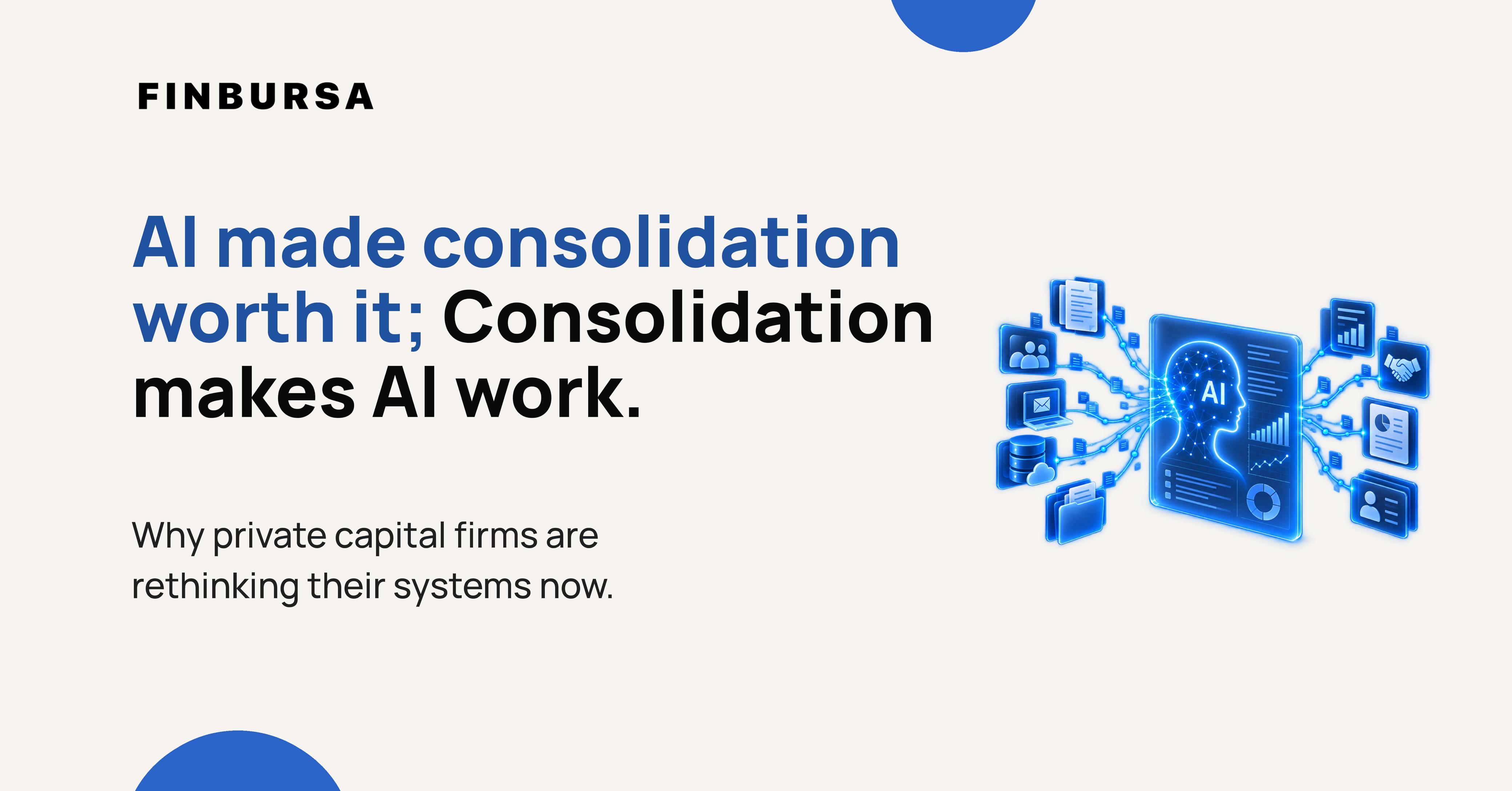
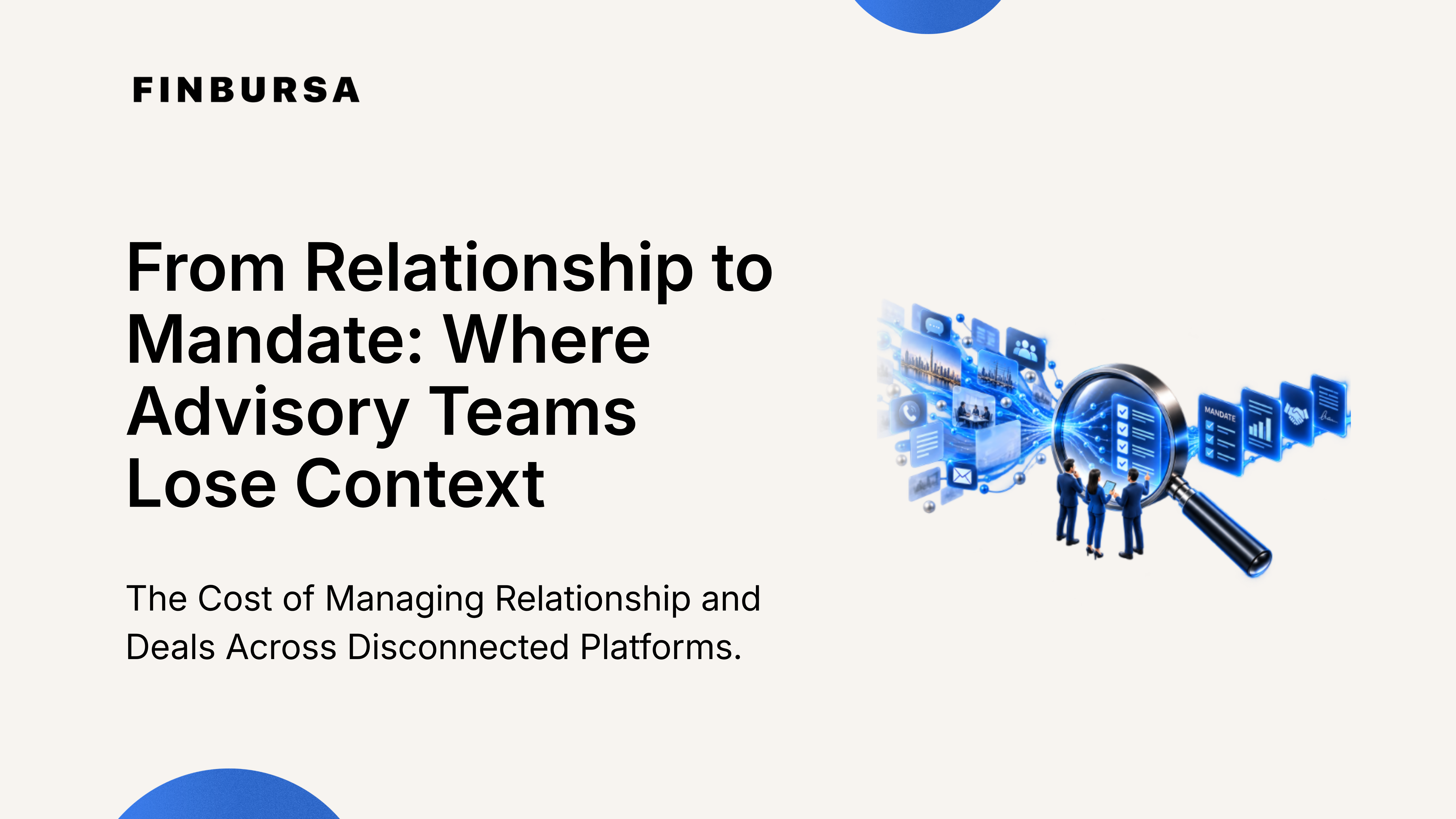
Private markets data is fragmented by nature. Deal data sits in one system. Investor relationships sit in another. Due diligence documents sit in a virtual data room. Reporting sits in a spreadsheet. Communications sit in email inboxes. Each source is disconnected from the others.
AI applied to any one of these sources in isolation produces limited insight. AI that has access to the connected picture — deal history, investor behaviour, document engagement, market context — can surface intelligence that meaningfully changes how professionals work.
Simple's 2025 Family Office Software and Technology Report found that integration and data quality have overtaken visual reporting as the top technology priorities for family offices — a shift from tool adoption to the harder, more consequential work of building connected operational systems.
This framing is instructive. The value of AI in private markets scales directly with the quality of the data infrastructure underneath it. Firms building connected data environments now — where deal management, investor relationships, document management, and communications share a common data layer — are investing in their capacity to apply AI effectively as the tools continue to mature.
Practical Implications
The operational shift plays out differently across the three main participants in private markets — but the underlying requirement is the same for each.
For fund managers
The most immediate opportunity is in investor communications and reporting. The administrative burden of LP reporting is well-documented and largely addressable. A quarterly reporting cycle that currently consumes three weeks of junior analyst time and delivers data that is already ten weeks old by the time it reaches an LP is not an unsolvable problem. Structured portfolio data connected to AI-assisted reporting tools can materially reduce production time while improving consistency and personalisation across an LP base.
For family offices
The priority is consolidated portfolio visibility. A real-time view across funds, direct investments, co-investments, and real estate — with current valuations, cash flow history, and projected capital calls — is something most family offices do not have today in a single accessible format. Building the data infrastructure to make that view possible is the prerequisite for any AI layer to add meaningful value on top of it.
For wealth managers
The challenge is scale. Managing reporting and investor communications for 50 or 100 client families each with bespoke private market portfolios requires operational infrastructure that most boutique wealth managers currently lack. AI-assisted reporting tools applied to structured portfolio data can make this scalable without proportional headcount growth.
The Campden Wealth data is instructive here: 88% of North American family offices surveyed in 2025 have exposure to private markets. As allocations grow, so does the operational complexity. The firms that address that complexity systematically will be better positioned to serve their investors as the cycle continues to develop.
Where to Start
Closing the operational gap does not require a single large transformation. It requires starting with the foundations.
Connected data across deal management, investor relationships, and document management. Structured reporting workflows that reduce manual extraction and formatting. AI applied as an operational assistant — surfacing information, flagging what matters, drafting communications — with professionals maintaining full accountability for decisions and client relationships.
Preqin forecasts an across-the-board increase in fund inflow activity through to at least 2030, with 2025 identified as the low point of the current cycle. The private markets environment is improving. The operational challenge of managing larger and more complex portfolios effectively is not diminishing alongside it.
The firms that build connected infrastructure now are not making a speculative investment in future technology. They are addressing a documented, well-established operational gap that their investors are already asking about — and that the data consistently confirms is one of the industry's most widely shared frustrations.
The intelligence gap in private markets is real. The tools to close it are available. The question for practitioners is where to start building.
Sources Referenced
• Alternative Credit Council, Financing the Economy 2025
• McKinsey Global Private Markets Report 2026
• BlackRock 2026 Private Markets Outlook
• Moody's, Private Credit Outlook, January 2026
• Deloitte Private, Digital Transformation of Family Office Operations, 2024
• RBC and Campden Wealth, North America Family Office Report 2025
• JPMorgan Private Bank, 2026 Global Family Office Report
• IQ-EQ, Global Private Markets Predictions for 2026
• PwC, Family Wealth Report Family Office Investment Summit 2025
• Simple, Family Office Software and Technology Report 2025
• Preqin, Private Markets in 2030
FAQs
What is the biggest operational challenge for private equity fund managers today?
LP reporting is consistently cited as the most time-consuming operational burden. A typical quarterly reporting cycle for a mid-market fund with 80 limited partners involves manual data extraction from fund administrator statements, formatting, commentary, and individual distribution — a process that can take two to four weeks and still delivers information that is eight to twelve weeks old by the time it reaches investors. The core problem is fragmented data: deal information, investor relationships, and documents sit in separate systems with no shared data layer.
How are family offices using AI in their operations in 2025?
According to the RBC and Campden Wealth North America Family Office Report 2025, three times more North American family offices are leveraging AI to improve operations in 2025 compared to 2024. The most commonly cited applications are automated investment reporting, research summarisation, and data consolidation — operational tasks rather than investment decision-making. The same report found that 69% of family offices have now adopted automated investment reporting systems, up from 46% the prior year.
What does a private markets platform do for fund managers and wealth managers?
A private markets platform consolidates deal management, investor CRM, virtual data room, fundraising campaigns, and investor reporting into a single connected system. Rather than managing separate tools for each function — and manually transferring data between them — fund managers and wealth managers work from one environment where all information is shared. This enables AI to surface insights across the full picture: which investors are most engaged, which deals are progressing, which LP relationships need attention, and when reporting cycles are due.
Why is connected data infrastructure important for AI in private markets?
AI produces useful output in proportion to the quality and connectivity of the data it can access. In public markets, decades of standardised infrastructure means AI can draw on prices, filings, news, and portfolio data simultaneously. In private markets, data is typically fragmented across multiple systems. AI applied to a single data source — a CRM, or a standalone VDR — produces limited insight. AI applied to a connected platform — where deal data, investor behaviour, documents, and communications share a common layer — can surface intelligence that meaningfully changes how professionals work. The infrastructure decision is therefore more consequential than the AI tool selection.
What should fund managers look for in a private markets reporting platform?
The most important criteria are connectivity, ease of implementation, and investor experience. Connectivity means the reporting module shares data with deal management and investor CRM — so reports draw on live portfolio data rather than requiring manual re-entry. Ease of implementation means the platform works with existing back office and administrator outputs rather than requiring migration of historical data or replacement of existing systems. Investor experience means the LP-facing dashboard is professional, mobile-accessible, and clear enough that investors can understand their portfolio position without assistance.