The ROI of Vendor Consolidation
Fund managers, M&A advisors, and deal teams are paying for the same capability across multiple disconnected tools, and losing time, deals, and investor confidence in the gaps between them. The case for consolidation is financial, operational, and strategic. Here is the full picture.
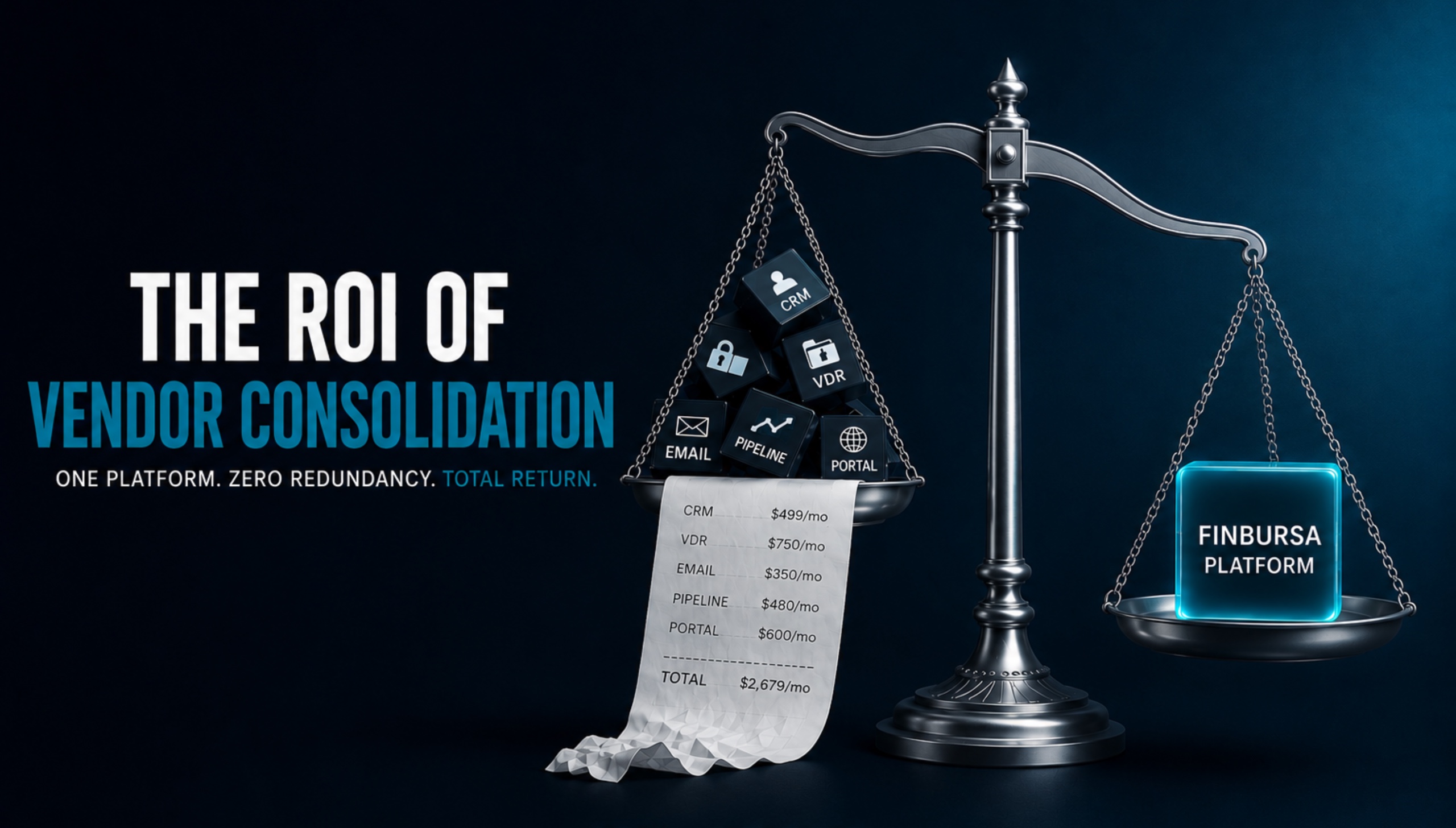 |
Count the tools your investment team runs to manage a single deal from origination to close. A CRM for investor contacts. A shared drive or generic tool for due diligence documents. A virtual data room provider selected deal by deal at full retail pricing. An email thread for fundraising pipeline. A separate tool, or none at all, for AI assistance. By the time a deal closes, it has passed through five or six systems that do not talk to each other. That is not a workflow. That is a fragmentation problem with a compounding cost.
Vendor consolidation, reducing the number of tools your firm relies on by migrating to an integrated platform that covers multiple workflows, is the most direct lever available to investment operations leaders looking to reduce cost, accelerate deal velocity, and improve the quality of investor-facing data. The ROI is measurable from year one and compounds every year after.
What fragmentation actually costs
The direct cost of running seven to twelve front-office tools is visible on the invoice. The indirect cost is larger and harder to see.
Every tool that does not connect to the others creates a manual handoff: a point where data must be re-entered, exported, or reconciled by a person. In deal management, that means deal status living in three places and being current in none. In fundraising, it means investor interest tracked in a spreadsheet that only one person updates. In VDR management, it means paying full per-deal pricing for access control and document management that an integrated platform would provide at a fraction of the cost. In investor relations, it means LP data siloed by fund with no firm-level view.
The operational cost is time. The strategic cost is decisions made on data that does not reconcile. The reputational cost is investor-facing outputs, including reports, data rooms, and pipeline updates, that reflect the fragmentation internally.
"Investment teams on consolidated platforms close deals faster, maintain cleaner investor data, and spend 38% less on technology than those running fragmented point-solution stacks." — Greenwich Associates, 2024
Where the ROI comes from
1. Direct cost reduction across deal workflows
Consolidating deal management, investor CRM, VDR, and fundraising tools onto one platform eliminates redundant per-seat and per-deal licensing immediately. VDR consolidation alone, replacing ad hoc per-deal provider selection with a firm-standard integrated capability, typically cuts data room spend by 40 to 60 percent within the first year. When combined with CRM and deal management licence rationalisation, most firms recover 30 to 45 percent of their combined front-office SaaS spend.
2. Deal velocity and pipeline visibility
When deal management, investor marketing, and fundraising execution live in one connected workflow, deals move faster. There is no re-entry of deal data between systems, no version conflict between the pipeline tracker and the CRM, and no lag between investor interest registered in one tool and visibility in another. Deal teams on integrated platforms consistently report shorter time from origination to first investor engagement and from investor engagement to close.
3. Investor data quality and LP confidence
Fragmented investor CRM and fundraising tools produce fragmented investor data. Contacts duplicated across systems, commitment records maintained separately from communication history, and LP-facing outputs assembled manually from multiple sources are each a source of error that eventually reaches an investor. A single investor CRM connected to deal rooms, VDR access logs, and fundraising pipeline produces one accurate view of every investor relationship and LP-facing outputs that reflect it.
4. Audit trail and regulatory readiness
Every workflow in investment management, from deal origination and investor onboarding through data room access and fundraising activity, generates an audit trail that regulators and institutional LPs will eventually examine. Fragmented tools produce fragmented trails: access logs in one system, communication records in another, document versions in a third. An integrated platform generates a single, continuous audit trail across the full deal lifecycle, reducing compliance overhead and strengthening the firm's position in due diligence and regulatory review.
5. AI that works in context
AI tools bolted onto fragmented stacks have no context. They operate on whatever data is in their own system, which is never the complete picture. AI built into an integrated investment platform has access to deal data, investor relationships, document history, and fundraising pipeline simultaneously. The result is assistance that is actually useful: surfacing the right investor for a deal, flagging stalled pipeline, or accelerating data room preparation based on the actual state of the workflow, not a disconnected slice of it.
| Front-office workflow | Fragmented stack | Consolidated platform |
| Deal management | CRM + spreadsheets + shared drives | Single deal workflow with portals and deal rooms |
| Investor marketing | Email campaigns and ad hoc outreach | Private marketplace with tracked investor interest |
| Fundraising execution | Email threads and manual pipeline | Active deal execution with AI-assisted workflows |
| Data room (VDR) | Per-deal provider at retail pricing | Firm-standard VDR, integrated, volume-priced |
| Investor CRM | Contacts siloed per fund or team | Unified CRM connected across all deal workflows |
| AI assistance | Separate subscriptions, no context | Native AI agents across deal, fundraising and VDR |
Sources: Greenwich Associates 2024; Aite-Novarica 2024; Broadridge 2024; Deloitte 2025.
How to consolidate: the short version
Map every tool to a workflow
List every active front-office subscription, covering deal tracking, CRM, data rooms, fundraising tools, and AI subscriptions, and map each to the specific workflow it serves. Where two or more tools serve the same workflow, that is your first consolidation target.
Start with VDR and deal management
VDR consolidation delivers the fastest ROI with the lowest migration risk: no complex data migration, immediate cost recovery, and improved security consistency from day one. Deal management and investor CRM consolidation follows naturally once a single deal workflow platform is in place.
Consolidate fundraising into the deal workflow
Fundraising pipeline that lives separately from deal management and investor CRM will always require manual reconciliation. Bringing fundraising execution, covering investor outreach, interest tracking, and deal room access, into the same platform as deal management eliminates that reconciliation entirely.
Require approval for any new tool
Consolidation is reversed faster than it is built. Require senior sign-off for any new front-office SaaS subscription. Publish an approved tool list and enforce it. Every tool added outside the approved stack restarts the fragmentation cycle.
The bottom line
Year one: VDR, deal management, and CRM consolidation recovers the cost of the programme. Year two: deal velocity improves as a unified workflow replaces manual handoffs between disconnected tools. Year three: AI assistance built into the consolidated platform, with full context across deals, investors, and documents, becomes a genuine competitive advantage rather than a disconnected subscription.
The investment firms that consolidate their front-office technology now will move faster, spend less, and make better-informed decisions than those that don't. That gap widens every year.
FAQs
What is vendor consolidation for investment firms?
Replacing the collection of disconnected tools, covering deal CRM, data rooms, fundraising trackers, investor portals, and AI subscriptions, with a smaller number of integrated platforms that cover multiple workflows on a shared data model. Less cost, less manual reconciliation, and better data quality across every investor-facing output.
Which tools are most commonly consolidated in investment front offices?
Deal management and pipeline tracking tools, investor CRM platforms siloed by fund or team, virtual data rooms selected on a per-deal ad hoc basis, fundraising execution tools running separately from deal workflows, and AI subscriptions with no access to deal or investor context. These five categories together represent the majority of recoverable spend in most investment front offices.
How much can investment firms save through vendor consolidation?
30 to 45 percent on direct front-office software spend within 12 to 18 months, with VDR consolidation alone delivering 40 to 60 percent savings on data room costs. Including the operational labour savings from eliminating manual reconciliation between disconnected systems, total ROI typically reaches 50 to 65 percent of pre-consolidation combined spend.
Does consolidation reduce deal flexibility?
Not when the platform is modular. The risk is a monolithic system that cannot adapt to deal-specific requirements. A modular integrated platform where deal management, VDR, investor portal, and CRM operate as connected modules rather than a single rigid system preserves the flexibility to configure workflows per deal type while maintaining a single data model across all of them.
How long does front-office consolidation take?
VDR consolidation: 4 to 8 weeks. Deal management and CRM consolidation: 2 to 4 months. Fundraising workflow integration: 3 to 6 months. Sequence VDR first for fastest cost recovery, then deal management and CRM, then fundraising. Run parallel systems through at least one complete deal cycle before decommissioning legacy tools.