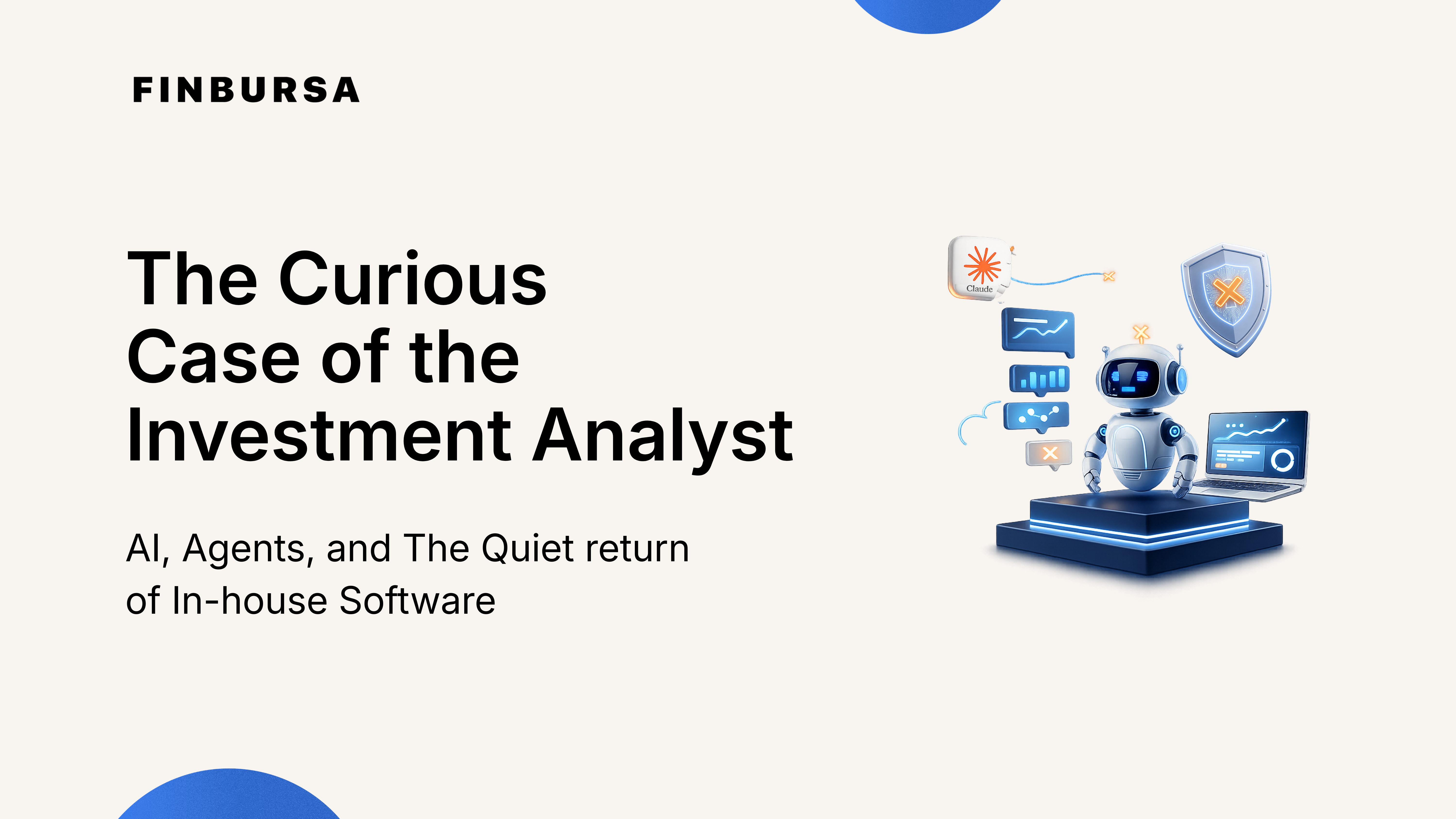
AI, agents, and the quiet return of in-house software.
A CIO at an asset manager told me recently: “I used to have one IT guy. I woke up one morning and I had fifty. The investment team, the fundraising team, everyone is building something.”
He wasn’t complaining, exactly. What his people are building works. An analyst connects an agent workspace like Claude Cowork or Copilot to the firm’s drive, the CRM, her inbox. She asks it to pull three quarters of portfolio reporting, reconcile the numbers against the model, and draft the quarterly update. A week of work takes an afternoon. The output is good. The partners are delighted.
Nothing about that Tuesday is a problem. This article is about the third or fourth Tuesday after it.
 |
Where does the truth live?
Agents are excellent labor. What they are not, on their own, is a system of record. And the line between those two things gets crossed quietly, because on both sides of it the work looks identical.
On the good side of the line, which covers most of an investment professional’s day, the agent reads from real systems and a human checks what comes out. The fund admin holds the numbers, the CRM holds the relationships, the data room holds the documents. The agent researches, screens, reconciles, drafts. If the analyst quits on a Friday, the firm loses some clever prompts. Annoying, and cheap to rebuild. Use agents for all of this, aggressively. That’s not a concession. That’s the point of the technology.
On the other side, somewhere around the third Tuesday, the session has started holding things instead of reading them. The adjusted figures, the ones that differ from what the fund admin shows for reasons the analyst worked out with the agent back in March, exist nowhere else. The logic for choosing between two conflicting numbers lives inside a conversation. Nobody decided this. It happened one convenient afternoon at a time.
“But the source systems are still there”
True. And this is where the problem gets subtle enough to be dangerous, so it’s worth being precise.
Connect the agent to your systems and the raw data is perfectly safe. Delete every session tomorrow and the fund admin still has every number it ever had. So what’s lost?
Try to answer an LP’s question about a reported figure two quarters later and you’ll find out. The data is there. The number isn’t reachable from it. What’s lost is the adjustments the analyst agreed with the agent, the records as they stood on the day the agent read them (the systems are live; they have moved since), and the path from inputs to output. None of that was ever written down anywhere. It was a conversation.
The ingredients are all in the fridge. The dish cannot be re-cooked, because the recipe never existed. And what LPs, auditors and regulators ask about is never the raw data. It’s the number: where it came from, and whether you can reproduce it.
“But AI makes mistakes, so why use it at all?”
Because the alternative never had clean hands either. The pre-AI industry ran on spreadsheets, and study after study found errors in most large spreadsheets. Funds have restated numbers over a dragged formula. Humans mistyped inputs into perfectly coded systems every single day.
The old stack’s real gift was never zero errors. It was that errors were catchable. The formula could be inspected, the input was logged, the wrong number could be traced, fixed, and proven fixed. That property has a boring name, auditability, and it is the entire reason institutional capital trusts reported numbers at all.
Agents bring a new species of error, fluent and confident, alongside enormous speed. Fine. That trade is worth making. But it’s only worth making if the old gift survives it. An agent whose work lands in a governed system, inputs preserved, logic stored, output written back, makes mistakes that can be caught, same as it ever was. An agent whose work lives in a personal session makes mistakes that can only be believed or disbelieved. Both agents may be right. Only one can be checked.
The costs nobody budgets
Even setting risk aside, the economics of the do-it-yourself route deserve daylight, because they’re documented and they’re not small.
The oldest finding in software is that building is the cheap part. Maintenance runs 60 to 80 percent of a system’s lifetime cost, a figure that predates AI by decades. AI collapsed the build cost, which fools people into thinking the whole thing is free now. It isn’t. The connectors change, the models change, the edge cases pile up, and someone has to notice.
Who? Hire an AI architect full time and you’re at $150,000 to $250,000 a year before benefits, paid alone, for one firm, while a software vendor pays that salary once across hundreds of clients. Most firms will do the sensible-sounding thing instead and bring in a consultant a few days a month, which solves the salary and recreates the disease: the one person who understands the workflows now leaves by design, on an hourly rate. Or let the analyst keep doing it. A day a week of a $200,000-a-year professional is a $40,000 engineering budget that appears in no budget.
And one more thing, easy to miss. The AI platforms themselves are serious companies, certified and encrypted, often more so than the niche software in a typical fund’s stack. The tool is not the gap. But every protection a firm normally relies on, the data export, the retention schedule, the restorable backups, the indemnities, the phone number to call, attaches to a product someone contracted for. None of it attaches to a workflow improvised on a personal account holding numbers that exist nowhere else. LP due diligence teams have started asking how firms use AI. “Our analysts connected things themselves” is the true answer at a lot of firms right now. It is not a good one.
One question
So here is the test, and it takes ten seconds in a Monday meeting:
If we deleted every personal agent session in the firm today, would any number we rely on disappear?
If no, relax. The agents are doing labor, the systems are holding truth. Push harder. If yes, or if nobody in the room knows, then somewhere a chat session has become a system of record, with no owner, no log, and no plan for the day its author resigns.
Agents need a home The answer to fifty accidental IT guys is not fifty fewer builders. It is one floor under all of them: real records underneath, inputs preserved, outputs written back, one permission model, one person accountable for what goes out.
I’ll also say something my side of the table rarely says. Part of this problem belongs to the vendors. AI has gutted the cost of building workflows, so software firms can no longer price as if features were the moat. The value now is the substrate, and vendors who keep pricing like it’s 2019 are practically inviting clients to build at home. Fair enough. Let the decision be won on honest arithmetic.
On honest arithmetic, though, the substrate’s cost gets paid one of three ways: a subscription, a salary, or an incident. Every firm pays it in one of those forms. The only real choice is which.
The disclosure
Full transparency: the author sells the kind of substrate this article says agents need, which makes him precisely the person you would expect to write it. Discount accordingly. But the argument only asks one thing, that someone in the building can answer a single question: if the sessions vanished tonight, what else vanishes with them? Firms with a good answer can safely ignore everything above. Ismail Badereldine is the CEO of FinBursa, the AI-native platform for private markets. This article reflects the author’s views on industry trends and is provided for informational purposes only. It does not constitute investment, legal, or tax advice. Cost figures are indicative market ranges from public salary and industry research and vary by geography and firm. AI-generated analysis, including outputs from any software platform, can contain errors and should always be reviewed by qualified professionals; investment decisions should never be based on AI outputs alone.