Investment teams have unique needs that go far beyond standard contact and pipeline management. Deal origination, investor relationship depth, virtual data room coordination, and live fundraising campaigns all require a platform built specifically for that complexity — and purpose-built investment CRM delivers exactly that.
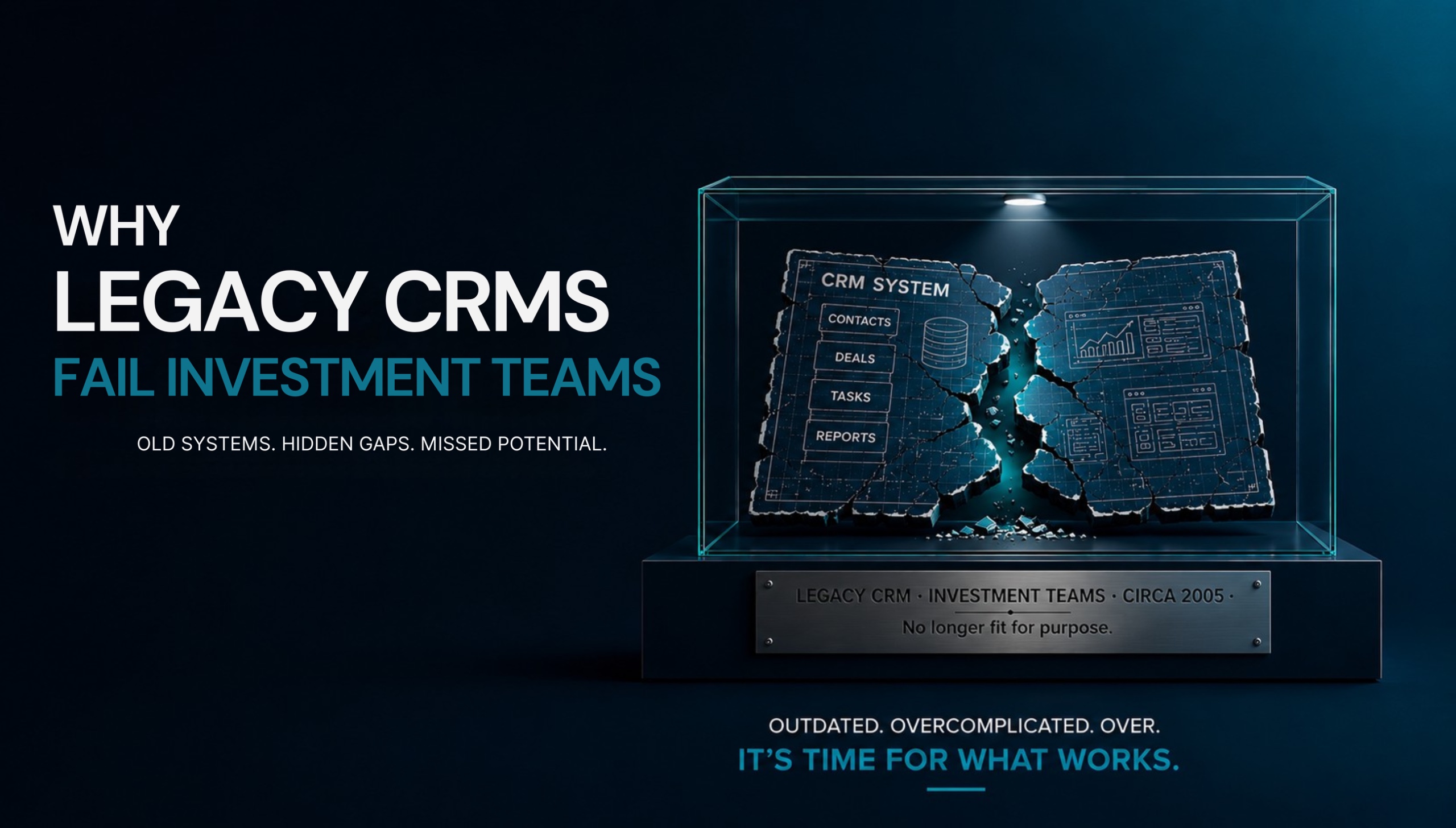
The firms gaining a structural edge today are those running on platforms where deal origination, investor CRM, virtual data room integration, and campaign execution all operate from a single connected system. The result is faster deal cycles, stronger investor relationships grounded in real engagement data, and fundraising campaigns that run without manual workarounds.
This is not a technology upgrade. It is a structural shift in how deals are originated, managed, and closed — and for fund managers, M&A advisory firms, family offices, and investment syndicates operating in competitive markets, the advantage compounds with every deal cycle.
"A platform built around investment workflows turns every data point — document access, investor engagement, pipeline movement — into deal intelligence."
The five capabilities that define a purpose-built investment platform
Purpose-built investment platforms are not general CRMs with investment-flavoured customisation. They are built around a fundamentally different data model — one designed for the complexity of live deal management from the ground up. Here are the five capabilities that set them apart.
Native deal flow architecture
A purpose-built investment CRM is built around deals and mandates, not contacts adapted into a sales pipeline. Investment opportunities move through customisable pre-investment stages, linked simultaneously to multiple investor and company relationships, with the right context surfaced at every stage of assessment. The result is pipeline data that teams actually trust for investment decisions.
Investor relationship management built for mandate complexity
Every investor relationship carries mandate fit, historical interest signals, document access history, communication threads, and deal room participation — all in one view. Each investor is understood as a long-term relationship with specific appetite, access level, and engagement history that informs every future interaction across every deal cycle. Not a prospect to be converted. A relationship to be deepened.
VDR integration that turns document access into deal intelligence
When the virtual data room is natively connected to the investor CRM, document access events become live deal signals. Which investors opened the data room? Which materials drove the most engagement? Which investors progressed after accessing specific documents? These insights are visible in the investor relationship record and invaluable for managing active mandates. Investment teams no longer have to guess at investor intent — the platform surfaces it.
Fundraising campaigns built for how deals actually close
A fundraising or investment sales campaign involves multiple investor types, deal room access at different stages, co-investor coordination, advisor participation, and progress tracking across a live mandate with regulatory and confidentiality constraints. Purpose-built platforms provide an integrated investor portal, a deal room with multi-party access, and a campaign workflow that reflects the actual structure of how deals are brought to market and closed.
AI agents built on the right data model
AI assistance for investment teams is only as good as the data it operates on. When investor relationships, deal flow, VDR activity, and campaign performance all live in one connected platform, AI agents can surface relevant investor matches, track engagement signals, assist with document management, and identify pipeline movement in real time. These capabilities require an investment-specific data model to function. The intelligence is only as strong as the infrastructure beneath it.
What a purpose-built investment CRM actually delivers
The shift to a purpose-built investment CRM is not a migration project. It is a structural upgrade to the way a firm manages relationships, tracks deals, and runs investor campaigns. When the CRM is built around investment workflows from the ground up, the operational benefits are immediate and compounding.
A single connected record for every deal and every investor
A purpose-built investment CRM holds the full relationship context for every investor, every company, and every deal in one place. Mandate fit, communication history, interest signals, and engagement data are all visible in a single view. Deal teams make decisions from one source of truth — not from reconciling data across multiple tools.
Deal pipeline that reflects how investment teams actually work
Pre-investment workflow stages are customisable to the way each firm operates — not mapped onto a generic sales funnel. Every deal moves through stages that match the real assessment and closing process, with the right context available at each step.
Investor follow-up that never falls through the gaps
Because contact records carry deal-level context — mandate fit, interest history, prior engagement — investor follow-ups are timely, relevant, and informed. Teams stop missing the right moment and start building the kind of consistent engagement that deepens long-term investor relationships.
Fundraising campaign execution from within the CRM
Running a fundraising or investment sales campaign from a purpose-built CRM means investor targeting, outreach sequencing, interest tracking, and advisor coordination all operate from the same system. Pipeline visibility is live, not reconstructed after the fact from disconnected tools.
AI assistance that works on investment-grade data
When investor relationships, deal flow, and campaign performance all live in one connected CRM, AI agents can surface relevant investor matches, identify pipeline movement, and support campaign targeting in ways that require the right data model to function at all.
Is your team ready for an investment-grade platform?
These are the operational signals that investment teams consistently identify when evaluating a purpose-built platform.
- Deal pipeline status is maintained in a spreadsheet alongside the CRM because a single connected record does not yet exist.
- Investor engagement history and document access data live in different systems with no connection between them.
- New team members take months to understand which system holds which information about a live deal.
- Fundraising campaign performance cannot be measured without pulling data from three or more separate tools.
- Co-investor and advisor coordination happens over email because there is no shared deal environment.
- Investor follow-ups are missed because contact records do not carry deal-level context or interest signals.
- AI tools have been evaluated but cannot be deployed effectively because the underlying data is too fragmented to build on.
- Every new mandate requires a new set of workarounds to make existing tools fit a workflow they were not designed for.
Purpose-built investment CRM: what it includes
| Function | Purpose-Built Investment CRM |
|---|---|
| Deal flow management | Custom pre-investment workflow stages |
| Investor relationships | Mandate fit, interest history, deal access |
| VDR integration | Native, connected to investor record |
| Fundraising campaigns | Investor portal and deal room campaigns |
| Co-investor coordination | Shared deal rooms with role permissions |
| AI assistance | Investment-specific AI agents |
| Investor portal | Built-in investee and investor portals |
| Audit trail | Full multi-level access and document audit |
| Deal marketplace | Reverse inquiry and cross-asset listings |
| Onboarding time | Configured for investment workflows on day one |
FAQs
What is investment CRM software and how is it different from a regular CRM?
Investment CRM software is a relationship and deal management platform specifically designed for fund managers, M&A advisors, family offices, and investment syndicates. Unlike general-purpose CRMs built for sales pipelines, investment CRM software manages pre-investment deal stages, investor mandate fit, multi-party deal room access, document engagement tracking, and fundraising campaign workflows. The core difference is the data model: investment CRM is built around deals, mandates, and investor relationships rather than contacts and sales accounts.
Why do fund managers need a dedicated deal flow management platform?
Fund managers need a dedicated deal flow platform because the complexity of managing live investment opportunities, investor relationships, virtual data rooms, and fundraising campaigns simultaneously cannot be handled effectively by a general-purpose CRM. A purpose-built deal flow platform connects deal origination, investor matching, VDR access, and pipeline tracking in one system, reducing manual administration, improving investor response times, and giving teams real-time visibility into where every deal and every investor relationship stands.
What features should an investment CRM include for M&A advisory firms?
An investment CRM for M&A advisory firms should include customisable deal workflow stages, native virtual data room integration with document-level access controls, investor and buyer relationship management with mandate tracking, deal room collaboration for multi-party transactions, fundraising and sales campaign tools, an investor portal for external access, full audit trail capabilities, and AI-assisted deal matching and engagement analysis. These features need to be connected in a single platform rather than assembled from multiple tools.
How does a virtual data room integrate with investment CRM?
In a purpose-built investment platform, the virtual data room is natively connected to the investor CRM so that document access events, download activity, and permission changes are reflected directly in the investor relationship record. This means deal teams can see which investors accessed which documents, when, and for how long — turning VDR activity into live deal intelligence rather than isolated file access logs.
What is a reverse inquiry model in investment platforms?
A reverse inquiry model in investment platforms allows deal providers such as startups, secondary sellers, and companies seeking capital to make themselves discoverable to investors who are actively searching for opportunities matching their mandate. Rather than relying on direct outreach alone, the reverse inquiry model creates a two-sided marketplace dynamic where investor appetite and deal supply are matched through the platform, increasing origination efficiency for both sides of the transaction.
How do AI agents improve investment deal workflows?
AI agents in investment platforms can assist deal teams by matching opportunities to investor appetite based on historical mandate data, tracking document engagement in the VDR to surface interest signals, identifying pipeline movement patterns, supporting fundraising campaign targeting, and assisting with document and data room management. These AI capabilities require an investment-specific data model to be effective. The intelligence is only as strong as the infrastructure beneath it.
The Verdict
The firms moving to purpose-built investment platforms are not reacting to a problem. They are claiming a structural advantage that compounds across every deal cycle.
Faster deal origination. Stronger investor relationships grounded in real engagement data. Fundraising campaigns that run from a single connected system. AI assistance that actually works because it is built on the right foundation.
Purpose-built investment technology is not a future consideration. For the firms winning mandates and closing deals in competitive markets today, it is already the baseline.