There is a conversation that happens in almost every private markets firm at some point, usually triggered by a specific failure — a deal that moved slower than it should have, an LP reporting update that went out with an error, a document that could not be located when it was needed. The conversation goes: we need better tools or a connected investment platform. And then, usually, someone buys a new tool often deal management software or an investment CRM. And then, six months later, the same conversation happens again.
 |
The problem is not a shortage of investment software. The private markets technology market has never had more options. There are dedicated CRMs for investor relations (investment CRM), standalone virtual data room platforms (VDRs), separate LP portals, pipeline trackers, reporting platforms, and document management tools all competing for the same operational budget. Some are pitched as an alternative investment platform, an integrated investment platform, or even a deal flow management platform. A firm could subscribe to ten of them and still be running its actual day-to-day workflow on email threads and spreadsheets, because none of the tools they bought are talking to each other as a connected investment platform.
This is the infrastructure problem in private markets specifically, a private markets infrastructure problem and, increasingly, a private equity infrastructure challenge. Not a lack of tools. A lack of connection between them. Disconnected tools reproduce the same fragmentation problem that spreadsheets create, just in a more expensive form.
Why the email and spreadsheet persist
Before diagnosing the infrastructure problem, it helps to understand why email and spreadsheets are so persistent in an asset class that manages trillions of dollars in capital. The answer is not that private markets professionals are unaware of better options. It is that email and spreadsheets have genuine advantages that make them hard to displace without a properly connected alternative, namely, a connected investment platform that feels as flexible as the current workflow.
Email is flexible. It handles any kind of communication, any counterparty, any content type. It requires no setup, no permissions, no training. A spreadsheet is similarly flexible, it can model anything, track anything, be shared with anyone. The reason these two tools remain at the center of so many private markets operations is that every alternative has historically been more rigid, more expensive to set up, and less interoperable with everything else the team uses.
The implication is that replacing email and spreadsheets in private markets does not require a more sophisticated version of either. It requires a connected platform where the information currently distributed across email inboxes and spreadsheet files lives in a single place that every relevant person can access, update, and act on. That is a fundamentally different proposition from buying a better spreadsheet or a smarter email tool. It is the work of building private markets infrastructure on a truly integrated investment platform.
What fragmented tools actually cost
The cost of running private markets operations on fragmented tools is rarely calculated explicitly, which is part of why it persists. The individual line items are visible, software subscriptions, headcount, occasional consulting. The aggregate cost of the fragmentation itself is not.
It shows up in the time a deal team spends copying information from one system to another. In the LP reporting cycle that was sent with last quarter's figures because nobody realized the spreadsheet had not been refreshed. In the senior analyst who spent three weeks every quarter producing a report that should take three days. In the co-investment opportunity that moved to another firm while the team was still reconstructing their current exposure from multiple sources to evaluate whether it fit.
These are not hypothetical costs. They are the operational reality of most private markets firms running on a stack of disconnected tools, and they have a direct impact on deal outcomes, investor relationships, and team capacity.
RELATED READING ON FINBURSA (Finbursa / finbursa)
The Frankenstein Tech Stack: Hidden Costs
A detailed breakdown of what fragmented deal tools are actually costing investment firms — including the hidden costs that never appear on a single invoice.
What the word infrastructure actually means here
Infrastructure is a word that gets used loosely in private markets technology conversations, often as a synonym for software or platform. It is worth being precise about what it actually means, because the distinction matters for how you evaluate and build it.
Infrastructure in private markets means a connected data layer that sits underneath every operational function, deal management, investor relationship management, document storage and diligence in a virtual data room, and reporting so that information entered or captured in any one of these functions is immediately available to all the others without manual transfer. This is the essence of private markets infrastructure and, for many firms, a subset of broader private equity infrastructure needs.
A CRM that holds investor records but knows nothing about what those investors have accessed in the virtual data room is not infrastructure. It is a contact database with a deal pipeline attached. A VDR that stores documents but does not connect access events to the investor relationship record is not infrastructure. It is a secure file repository. Infrastructure is what happens when these functions share a common data model, so that every action in any one of them creates a signal that every other function can see and act on.
The reason this distinction matters is that it determines what you actually build toward. If infrastructure means software, you buy tools. If infrastructure means a connected data layer, you choose a platform, ideally an integrated investment platform or evaluate tools specifically on whether they contribute to a connected whole rather than adding another isolated layer.
What connected private markets infrastructure actually enables
When private markets infrastructure is genuinely connected, four things change in ways that are immediately operational rather than theoretical.
First, information stops needing to be moved manually. A deal that progresses in the pipeline does not require someone to update three separate systems. An investor who accesses a document in the virtual data room does not require someone to manually log that event in the CRM. The information moves because the systems share it, not because a person transfers it.
Second, the people managing deals and investor relationships spend their time on judgment rather than administration. The hours currently consumed by data reconciliation, report production, and system updating become hours available for analysis, relationship development, and decision-making.
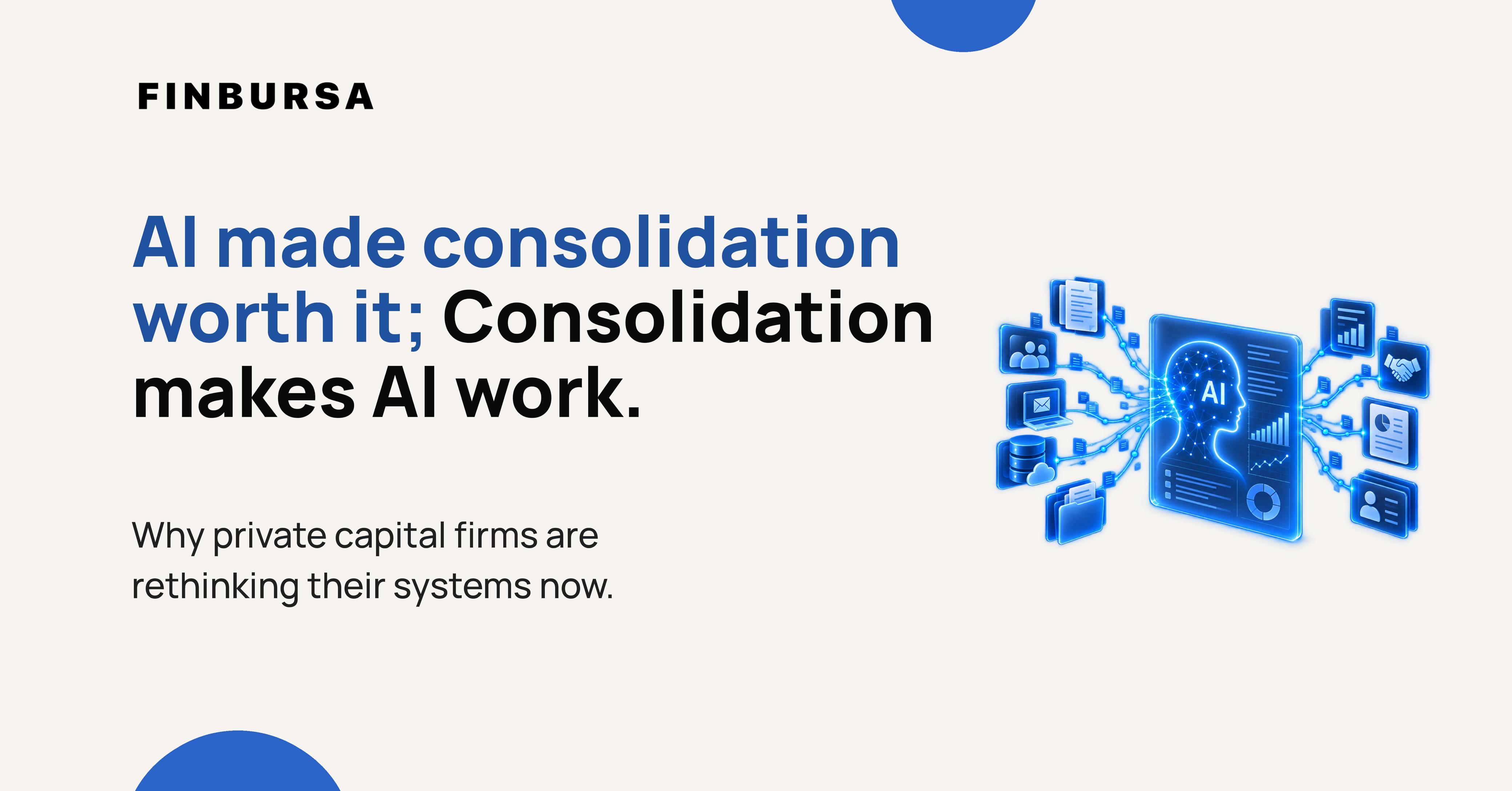
Third, AI becomes genuinely useful. This is the connection that is most frequently missed in private markets technology conversations. AI investment software applied to connected private markets infrastructure produces specific, actionable insight because it has access to the full picture deal data, investor behaviour, document engagement, portfolio performance simultaneously. Applied to fragmented data in disconnected tools, the same AI produces partial, often unreliable output. In practice, this is where AI deal management and related decision support tools thrive when they operate on a unified, connected data layer rather than silos.
Fourth, the firm becomes less dependent on key individuals as the institutional memory of the operation. When information lives in connected systems rather than in individual inboxes and personal spreadsheets, it does not leave when a team member does.
RELATED READING ON FINBURSA
Private Markets Manage Trillions. Most Still Run on Spreadsheets.
Why the operational infrastructure managing much of the world's private capital has not kept pace with the asset class it serves — and what is finally changing.
Where to start building it
The practical question for most private markets firms is not whether to build connected infrastructure but where to start. Not everything can be connected at once, and attempting a full platform migration while managing active deal flow is operationally disruptive in ways that are hard to justify.
The most effective starting point is almost always the connection between deal management and investor relationship management. These two functions share more data than any other pairing in private markets. Every deal involves investors, every investor relationship involves deals and the manual work of keeping them synchronized in separate systems is one of the highest-cost inefficiencies in the stack. Practically, that usually means ensuring the investment CRM (investment crm) and deal management software are bi-directionally connected.
Once that connection exists, adding VDR integration, investor portal capability, and reporting automation each adds incrementally to a connected whole rather than reproducing the disconnection in a slightly different configuration. The infrastructure builds in layers, but each layer needs to connect to what is already there rather than sitting alongside it. Over time, this begins to resemble an integrated investment platform or connected investment platform rather than a toolkit.
The verdict
The email thread and the spreadsheet are not going away because nobody has invented a better tool. They are going away, slowly, in the firms that have recognized that the problem is not tool quality but data connection. A better CRM that does not talk to the virtual data room is still a fragmented operation. A more sophisticated reporting platform that pulls data manually from three other systems is still producing the same quarterly headache, just with a nicer output format.
Private markets infrastructure, built properly, is not a technology project. It is an operational decision about where information lives, who can access it, and what happens to it automatically when something changes in the deal or the investor relationship. The firms that make that decision clearly, and build toward a connected whole rather than a longer list of subscriptions, find that the email threads and spreadsheets recede on their own — because there is finally somewhere better for the information to live.
FAQs
What is private markets infrastructure?
Private markets infrastructure refers to a connected data layer that links deal management, investor relationship management, virtual data room, and reporting functions so that information captured in any one area is immediately available to all others without manual transfer. It is distinct from individual software tools — infrastructure is defined by the connection between functions, not by the features of any single platform, and it is often delivered via an integrated investment platform.
Why do private markets firms still use spreadsheets and email?
Private markets firms continue to use spreadsheets and email because these tools are flexible, require no setup, and work with any counterparty or content type. The alternatives have historically been more rigid, more expensive to configure, and less interoperable with the rest of a firm's tools. Spreadsheets and email only recede when a connected investment platform provides a genuinely better place for the same information to live.
What does fragmented private markets technology actually cost?
The cost of fragmented private markets technology includes direct costs such as multiple software subscriptions with overlapping functions, and indirect costs such as the time spent manually transferring data between systems, delays in LP reporting, missed deal opportunities due to slow internal information assembly, and key-person dependency on individuals who hold process knowledge in personal inboxes and files rather than connected systems.
Why does AI require connected infrastructure in private markets?
AI investment software for private markets requires connected infrastructure because AI produces insight only from the data it can access. When deal management, investment CRM, virtual data room, and portfolio data exist in separate disconnected systems, AI applied to any one of them sees only a fragment of the relevant picture. Connected infrastructure gives AI access to the full data set — the prerequisite for the deal matching, engagement signal detection, AI deal management, and report generation capabilities that make AI genuinely useful in private markets operations.
Where should a private markets firm start building connected infrastructure?
The most effective starting point for building connected private markets infrastructure is the link between deal management and investment CRM, since these two functions share more data than any other pairing in the operational stack. Once that connection exists, adding virtual data room integration, investor portal capability, and reporting automation each contributes to a connected whole rather than adding another isolated tool. For some firms, this evolves into an alternative investment platform that consolidates core workflows without sacrificing flexibility.
How can we tell if we have true infrastructure or just more tools?
You have infrastructure when data entered in any function is instantly available to all others without manual transfer. Practical tests: a VDR access event appears on the investor's CRM record automatically; a deal stage change updates pipeline views and reporting without someone rekeying data; and teams are no longer moving information by email attachments or CSV uploads. If actions in one system don't create signals others can see and act on, you're still running a fragmented tool stack.
What is the smallest, high-impact step to start building connected infrastructure?
Bi-directionally connect deal management and the investment CRM. These two functions share the most data, and keeping them in sync manually is one of the biggest hidden costs. Once this link is live, layering in VDR integration, investor portal capabilities, and reporting automation adds to a connected whole instead of creating new silos.
How do we avoid recreating fragmentation as we add capabilities?
Evaluate every addition on whether it contributes to a common, connected data layer. Favor tools and configurations where actions in one function automatically generate usable signals in others (e.g., document engagement feeding investor relationship context). Avoid systems that "sit alongside" without bi-directional connection or a shared data model — they add features but not infrastructure.
What operational risks does a fragmented stack create beyond cost?
Fragmentation slows deals and degrades accuracy. It leads to reporting errors (e.g., stale figures), missed opportunities (e.g., co-investments delayed while exposure is reconstructed), and key-person risk when critical knowledge lives in inboxes and personal spreadsheets. These directly affect deal outcomes, investor trust, and team capacity.
Why is a phased approach better than a full platform migration?
Big-bang migrations are disruptive while active deals are in motion. Building in layers — starting with the CRM–deal management connection and then adding VDR, portal, and reporting — delivers immediate operational gains with less risk. Each layer must connect to what's already there, so the stack evolves into an integrated investment platform instead of a longer list of subscriptions.