An exit is the highest-stakes transaction most fund managers, founders, and advisors will run. Every day it extends beyond the expected timeline is a day of uncertainty for the seller, erosion of momentum for the buyer, and compounding risk for everyone at the table. The virtual data room sits at the operational centre of that process. And for most participants, it is still running on infrastructure that was designed for a different era.
 |
Legacy VDRs are not bad products. They solve the problem they were built to solve: secure, permission-controlled document sharing. What they do not solve is everything that surrounds that function in a modern exit process — the deal workflow, the counterparty relationship management, the real-time engagement signals, and the audit trail that connects document activity to decision context. When those capabilities are absent, the exit slows. Sometimes visibly. Often invisibly, in ways that only become clear after the deal has closed or fallen apart.
Five ways legacy VDRs are adding time and risk to your exit
The friction points are consistent across deal types and market conditions. They appear in private equity secondaries, M&A advisory mandates, venture-backed exits, and corporate divestitures alike. What varies is how visible they are — and how much they have already cost by the time they are identified.
Delay 01
No visibility into counterparty engagement
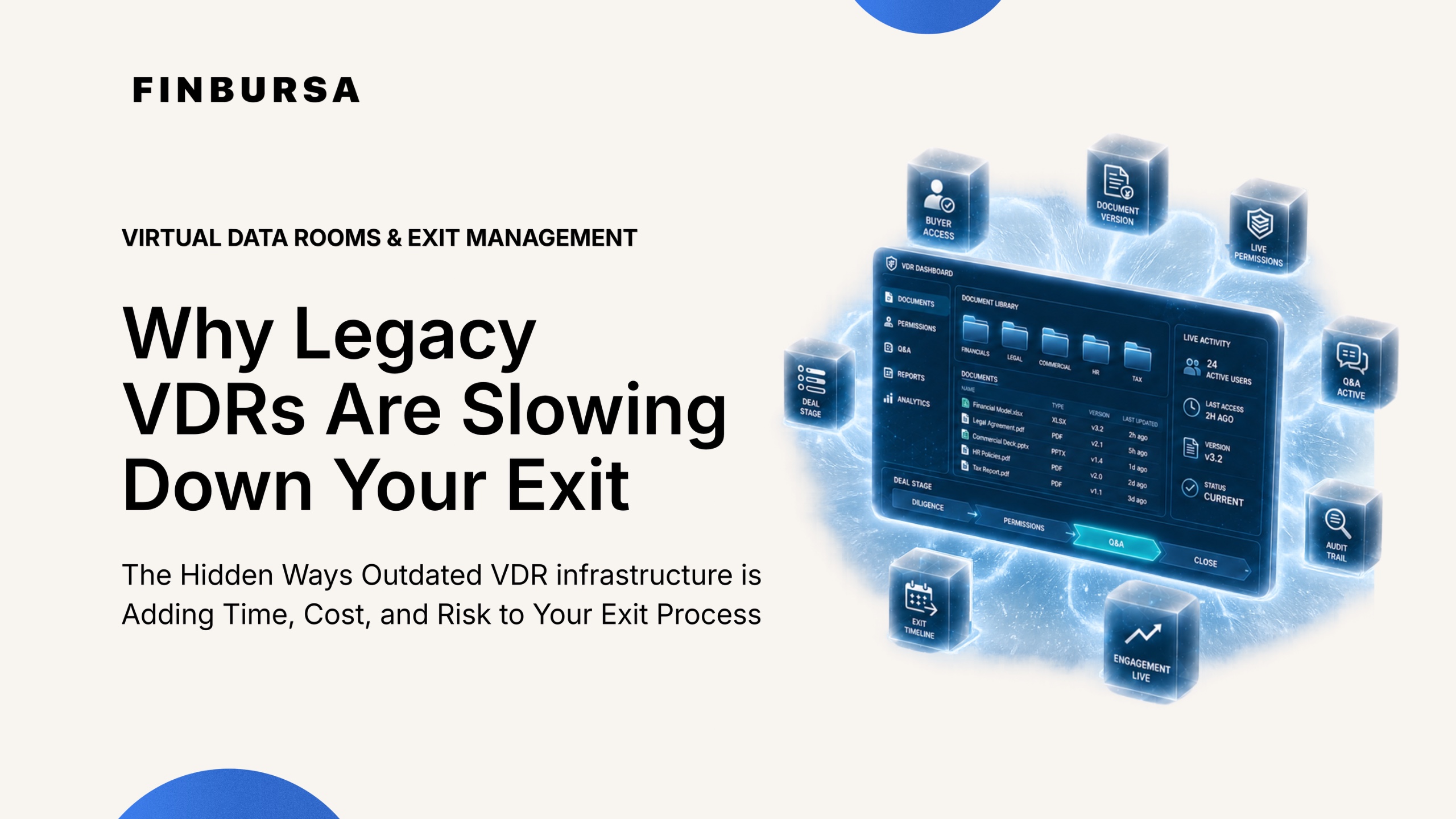
In a legacy VDR, documents are uploaded and access is granted. What happens next is largely invisible. Which buyer representatives opened the data room? Which documents did they spend time on? Which sections have been reviewed multiple times and which have not been opened at all? Without this information, the sell-side advisory team is managing the process on intuition rather than data. Follow-up timing is arbitrary. Re-engagement is reactive. And the signals that indicate a buyer is genuinely progressing versus stalling are missed entirely.
Delay 02
Document version chaos under deal pressure
Exit processes move quickly and documents change frequently. Financial models are updated. Legal exhibits are revised. Management presentations are refreshed. In a standalone VDR with no connection to the deal workflow, version management is a manual discipline. The wrong version of a document reaches a buyer. A revised exhibit is uploaded but existing access grants are not automatically updated. Buyers submit questions based on superseded materials. Each of these errors adds administrative time, erodes buyer confidence, and raises questions about the operational quality of the seller.
Delay 03
Permission administration as a full-time job
Managing access permissions across multiple buyer groups, each at a different stage of the process with different authorisation levels for different document categories, is a significant operational burden in a legacy VDR. It is managed manually, updated reactively, and frequently produces errors. A buyer who should have access to a document cannot find it. A document that should be restricted to one party has been inadvertently shared with another. Each of these incidents requires intervention, apology, and remediation — consuming time that should be spent on the commercial substance of the transaction.
Delay 04
Q&A processes that generate more questions than they resolve
Buyer questions during due diligence are a natural and productive part of any exit. The Q&A process in a legacy VDR is rarely either. Questions arrive in unstructured formats, are manually routed to the right subject matter expert, receive responses that are not automatically linked to the relevant document, and generate follow-up questions that repeat the cycle. A well-managed Q&A process accelerates the buyer's diligence and builds confidence. A poorly managed one signals disorganisation and extends the timeline by weeks.
Delay 05
Audit trail gaps at the moment they matter most
Post-signing, the data room audit trail becomes a legal and compliance document. Which party had access to which information at which point in the process? In a legacy VDR with no connection to the deal management system, that trail is incomplete. Access events are logged within the VDR but not connected to the broader deal record. Reconstructing a complete picture requires manual assembly from multiple sources — exactly when the deal team has the least bandwidth to do it.
The integration argument: why the VDR cannot stand alone
The case for a VDR that is natively integrated within the deal management platform is not primarily about convenience. It is about what becomes possible when document activity is connected to the deal and relationship record in real time.
As we examined in our analysis of why VDRs must live inside the CRM, the value shift is fundamental. When every document access event updates the buyer relationship record automatically, the sell-side team has a live view of engagement across all counterparties. Which buyer groups are active in the data room? Which have gone quiet? Which sections are generating the most attention and likely forming the basis of the next round of questions? This intelligence does not exist when the VDR and the deal management system are separate tools.
Permission management that is connected to the deal pipeline stage removes the manual administration burden entirely. As a buyer progresses from initial access to full due diligence, their permission level updates automatically based on where they are in the process. Version control is enforced at the platform level rather than managed manually. And the audit trail is complete and continuous because the VDR and the deal record are the same system.
The M&A advisory perspective
For independent M&A advisors managing multiple simultaneous mandates, the operational cost of legacy VDR infrastructure compounds with every transaction. Per-deal licensing, separate setup and configuration for each new mandate, and zero continuity of relationship intelligence between transactions means that the VDR function is both expensive and disposable.
In our guide to deal management and VDR software for independent M&A advisors, we explored how the economics of standalone VDR products work against boutique advisory firms specifically. The per-transaction cost model, combined with the absence of any accumulated intelligence value, means that advisors are paying more for less with every deal they run.
Signs your VDR is slowing down your current exit
• You cannot tell, right now, which buyer representatives have accessed the data room and which have not.
• A document version error has required you to contact buyers to disregard materials already shared.
• Q&A responses are being managed through email rather than a structured workflow connected to the data room.
• Granting or adjusting access permissions requires manual steps outside the deal workflow.
• Your team is spending more time administering the data room than analysing buyer engagement.
• You have no systematic way to distinguish between a buyer who is progressing diligence and one who has stalled.
• Post-signing audit trail reconstruction required pulling records from multiple systems manually.
The Verdict
A legacy VDR will get you through an exit. It will not get you through one faster, more professionally, or with the kind of buyer engagement intelligence that allows a sell-side team to act decisively at the moments that matter. Every day added to an exit timeline has a cost. Every version error that reaches a buyer has a cost. Every follow-up sent without knowing whether the buyer has actually engaged with the materials has a cost. These costs are real and measurable, even when they are invisible on any individual transaction.
The shift from a legacy VDR to an integrated deal platform is not a technology upgrade in the conventional sense. It is an operational decision about how much of your exit process you want to manage on instinct and how much you want to manage on data. The deals closing faster are being run by teams who know the answer to that question.
The question is not whether your current VDR is capable of completing the transaction. It is how much it is costing you in time, risk, and missed signals along the way.
FAQs
Why do legacy VDRs slow down M&A exit processes?
Legacy VDRs slow down M&A exits in five consistent ways: they provide no visibility into counterparty engagement with documents, making follow-up timing arbitrary rather than signal-driven; document version management is manual and error-prone under deal pressure; access permission administration is disconnected from the deal workflow and requires constant manual updates; Q&A processes are unstructured and extend diligence timelines unnecessarily; and post-signing audit trails are incomplete because VDR activity is not connected to the deal management record. Each of these frictions compounds over the course of a transaction, adding days and weeks to exit timelines.
What should a VDR include for M&A and exit transactions?
A VDR for M&A and exit transactions should include native integration with the deal management and CRM platform so document access events update the buyer relationship record in real time, multi-level access permissions managed at the deal pipeline stage rather than manually, watermarking tied to buyer identity, structured Q&A workflows connected to the relevant documents, version control enforced at the platform level, and a complete audit trail that covers both document activity and deal workflow context. These capabilities are not available in standalone VDR products that operate independently from the deal management system.
How does a connected VDR improve exit timeline management?
A VDR that is natively connected to the deal management platform improves exit timeline management by turning document access events into real-time deal intelligence. The sell-side team can see which buyer groups are active in the data room, which documents are generating the most engagement, and which counterparties have gone quiet — without logging into a separate system. This enables precise, signal-driven follow-up rather than arbitrary calendar-based outreach, which consistently reduces the time between diligence submission and buyer decision across M&A, secondary, and PE exit transactions.
What is the difference between a legacy VDR and a modern deal management platform?
A legacy VDR is a standalone document repository for secure sharing during due diligence, with no native connection to the deal pipeline, investor CRM, or fundraising workflow. A modern deal management platform with native VDR capability integrates document management with deal pipeline tracking, counterparty relationship management, Q&A workflow, access permission management, and audit trail in a single connected system. The practical difference is that document activity in a modern platform updates the deal record automatically, giving the deal team real-time intelligence on buyer engagement without manual data transfer between tools.
How much does a standalone VDR cost for an M&A transaction?
Standalone VDR costs for M&A transactions typically range from $15,000 to $60,000 per deal for mid-market transactions, with costs scaling by deal size, document volume, and the number of user access groups. These costs reset with each new transaction and accumulate no intelligence or relationship value across deals. Advisory firms and fund managers managing multiple simultaneous mandates can reduce overall VDR costs significantly by consolidating onto an integrated deal management platform where VDR capability is included as part of a single subscription rather than charged per transaction.