How Venture Capital Firms Should Run a Connected Front Office
At most venture funds today, deal research runs through two systems that never see each other. One is the firm's own infrastructure: a pipeline in Notion or Airtable, a shared drive of diligence documents, an inbox of introductions from founders, co-investors, and the venture scouts feeding the fund deal flow. The other is AI. For some teams, a personal chat window with nothing connected to it. For more advanced teams, an agent linked to the pipeline and Slack through general-purpose connectors.
 |
Either way, its view of the fund's own history is partial by construction. It sees what a connector happens to expose, not a permissioned, audited record of the deal itself. What it produces has no institutional home. No link back to the scout who sourced the company. No record for the next associate researching the same sector. No trail a partner or an LP could review after the fact.
An analyst asked to turn a company profile around before a partner meeting, for a founder surfaced by a scout the firm has worked with before but has no direct history with itself, spends the afternoon piecing one together anyway: a LinkedIn profile, a TechCrunch mention, an old email thread someone forwarded months ago. By evening the memo exists. By next quarter, when a different analyst is asked to look at a similar company in the same sector, none of that research is anywhere to be found. It happened once and vanished.
Venture capital sees more companies, more often, than any other class of private markets investor. That volume is why the tools a fund starts with rarely stay adequate for long.
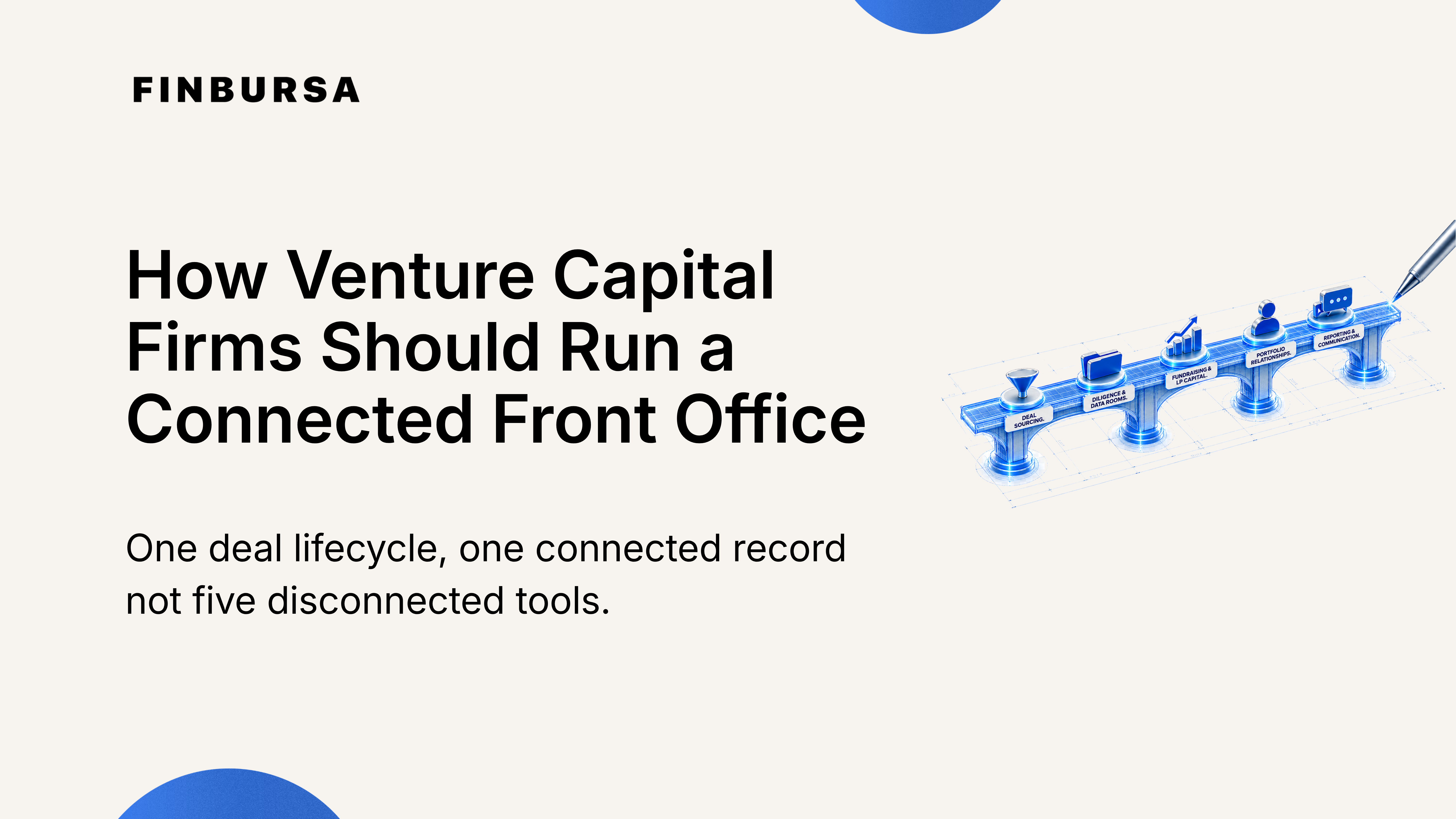
The deal lifecycle is one continuous thread, sourcing into diligence into the fund's relationship with a portfolio company for years afterward, but the tools most funds use to manage it are not. Every handoff between a pipeline database, a messaging app, and an inbox loses something: who sourced the deal, why a partner passed, what a founder actually needs right now. For a fund evaluating what actually makes the best CRM for venture capital firms, the honest answer is rarely a single tool. It's whether the whole lifecycle runs on one connected record or scatters across five.
The Volume Problem: Why Lightweight Tools Break as the Fund Grows
Most funds assemble their early infrastructure the same way: a flexible database, Notion or Airtable, typically, for the pipeline, a spreadsheet for whatever the database view doesn't cover, and a handful of general-purpose tools filling in the rest. LinkedIn carries sourcing and the informal networks of scouts many funds rely on for early signal. Slack holds the actual deal discussion: the reasoning behind a pass, a partner's read on a founder, separate from whatever the pipeline record shows. Mailchimp handles LP updates and founder newsletters. At ten deals a month, this works. A partner can hold the whole picture in their head.
Three things break as volume rises.
Sourcing attribution disappears. At low volume, a firm can track by memory which scout flagged which company first. Scouting deals across hundreds of opportunities a year, memory stops being a system. Once attribution is lost, so is the firm's ability to tell which relationships are actually producing deal flow and which have gone quiet.
Portfolio founders drift into email. The pipeline tool was built to evaluate a deal, not to hold the relationship after it closes. Board decks, updates, and follow-on conversations move into inboxes tied to whichever partner sits on that board, disconnected from the record that led to the investment.
LP relationships live in a separate world. By a fund's second or third vehicle, LP communication and engagement history typically end up in their own tool, unconnected to the deal and portfolio data that would give that communication substance.
None of this is a sign of a firm running loosely. It's what happens when volume, portfolio size, and LP count grow past what a stack assembled for ten deals a month was ever asked to hold.
The VC Operating Model That Scales
High-volume deal flow with attribution. Every company entering the pipeline, direct approach, co-investor introduction, or a scout's find, lands as one record connected to the source relationship, captured at first contact rather than reconstructed later from memory.
Pipeline at pace. Configurable stages, inbound, first call, partner meeting, term sheet, mirror how the fund actually screens, not a sales funnel repurposed for venture. IC memos and diligence notes attach to the deal record itself, not to a Slack thread that will scroll out of reach in a week.
Diligence per deal. Each company gets its own data room; founders upload through an Investee Portal rather than a shared drive folder someone assembled by hand. No per-deal fee, so the room exists from first contact instead of being delayed until a deal looks serious enough to justify setting one up.
Fund and deal-by-deal capital. LP fundraising and deal-by-deal co-invest syndication run through the same campaign structure, with allocation and KYC tracked per participant: one system, whether the capital is coming into the fund or into a single company.
The post-investment founder relationship. This is where most funds lose the most ground, and where a connected model earns its keep.
After close, the relationship with a portfolio founder usually moves into email: a board deck as an attachment, a financial update requested ad hoc, a follow-on conversation that happened over text and was never written down anywhere else. None of it connects back to the deal that produced the investment. None of it is visible to anyone but the partner who happened to be on that call.
A connected model keeps the relationship inside the same environment the deal was sourced and diligenced in. Founders submit updates, board materials, and financials through the Investee Portal they already used during diligence. No new channel standing up for every company at every stage. Board materials accumulate against the company's own record instead of scattering across whichever partner's inbox happens to hold them. When a co-investor asks what's changed since the last update, or a founder needs an introduction for a Series B, the answer already exists. It doesn't have to be reconstructed from memory under time pressure.
This matters more in venture than almost anywhere else in private markets, because the relationship isn't a byproduct of the investment. It's often the whole point of it.
The Cost of Tool Sprawl at Scale
Each tool in a lean fund's early stack looks cheap on its own: a database, a messaging app, a personal AI subscription. The expense lives in what sits between them, and it doesn't grow with headcount. It grows with the number of tools multiplied by the number of people trying to keep them in sync.
An associate reconciling the pipeline against a Slack thread, a scout's LinkedIn message, and a founder's emailed update is doing integration work, not investment work. Every new tool the fund adds to patch a gap adds another seam for someone to hold together by hand. That labor doesn't show up on an invoice. It shows up in how long a reporting cycle takes to close, and in how many weeks it takes a new hire to stop asking where things live. The true cost of running a fund this way rarely shows up as a line item. It shows up as time.
A platform built around full configurability, pipeline stages, scoring, and portal branding that adapt to how the fund already works rather than a template it has to bend around, removes the need to compensate for a rigid system with a patchwork of smaller ones. And because a lean team has no room to absorb an implementation project between fund closes, onboarding measured in days rather than quarters matters as much as any feature on a comparison sheet.
The Compliance Risk of Building Your Own Stack on General-Purpose AI
Some funds have already moved past copy-pasting into a disconnected chat window. A general-purpose AI agent connected to the pipeline, the shared drive, and Slack can read the deal record and draft a memo grounded in what the fund actually knows. That's real progress, and it's the direction most lean teams are heading.
It doesn't close the gap that matters for a regulated investment process. These agents are built as productivity tools for broad, cross-functional work, not as systems of record for one asset class. Their activity typically doesn't appear in a compliance-grade audit log, and connecting one to internal tools doesn't, on its own, produce the kind of permissioned, immutable trail an LP or an auditor expects to see reconstructed on request. The agent's context grows richer as more tools connect to it. The record of what it touched and who approved it doesn't grow the same way.
The sharper question for a fund evaluating its own AI posture isn't whether an agent can see the firm's data. It's whether what it produces, and how it got there, is something the firm could hand to an LP's counsel without having to rebuild it after the fact.
The Native Answer
This is the operating model FinBursa is built to run. Rather than a CRM adapted from sales tooling, bolted to a separate data room, with LP reporting handled by a third system again, FinBursa combines deal flow tracking, unlimited data rooms at no per-deal cost, fundraising and co-invest syndication, and an Investee Portal for the post-investment relationship, inside one environment built for how venture capital actually operates. Sourcing attribution is preserved automatically, from a scout's first introduction through to close. The founder relationship that starts in diligence continues through the same portal after the deal is done, so nothing about the company's history has to be rebuilt from memory a year later.
The analyst piecing together a company profile from a LinkedIn page and an old email thread is, specifically, the work this replaces: deal history, sourcing context, and founder relationships live in one place, available the moment someone needs them rather than reconstructed under deadline.
For the partner: see how sourcing attribution and portfolio founder relationships stay intact as the fund scales. Explore FinBursa.
For the platform or ops lead: see exactly how the pipeline, data rooms, and Investee Portal configure to your fund's own process. See the Venture Capital solution.
Read next: Why Private Markets Infrastructure Must Be Connected