The fundraising technology market has never had more options. There are dedicated CRMs for investor relations, standalone VDRs for due diligence, separate investor portals for LP access, campaign tools for outreach sequencing, and pipeline trackers for deal management. A motivated team could subscribe to all of them and still be less operationally effective than a team running a single integrated platform.
 |
This is the central tension in fundraising technology in 2026. The proliferation of specialised tools has created the illusion of sophistication while generating the reality of fragmentation. Data lives in different places. Signals do not flow between systems. The investor relationship is managed in one tool, their document engagement in another, and their campaign status in a third — and none of these three tools know what the others know.
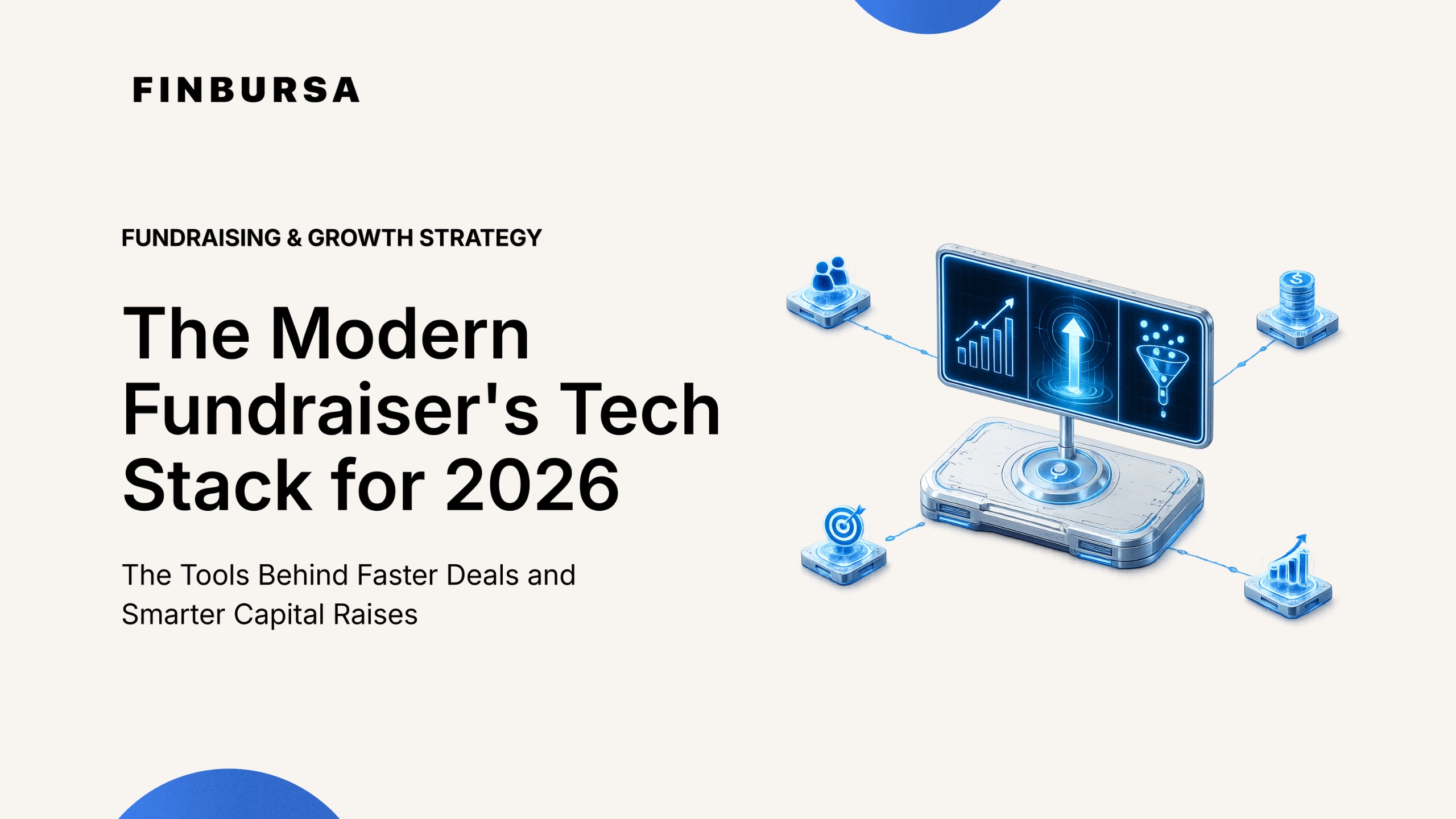
The modern fundraiser's tech stack is defined not by the number of tools it contains but by the degree to which those tools are connected. This blog defines what that stack should look like in 2026 and why the architecture matters as much as the individual components.
"In 2026, the fundraising advantage does not go to the team with the most tools. It goes to the team with the most connected ones."
What changed in fundraising technology between 2022 and 2026
Four years ago, best-in-class meant best individual tool. Fundraising teams evaluated each function separately — CRM, VDR, investor portal, outreach — and selected the strongest option for each. The assumption was that integration could be added later, or managed manually in the interim.
That assumption has proven expensive. The manual integration work between disconnected tools consumes hours per week per team member. Investor engagement signals generated in one system never reach the person who needs to act on them in another. And AI capability — which requires a connected data model to produce meaningful output — simply does not function across fragmented stacks regardless of how sophisticated the individual AI tools are.
The shift in 2026 is toward architectural thinking. The question is no longer which CRM is best or which VDR has the cleanest interface. The question is which platform connects investor relationships, document engagement, pipeline status, and campaign activity in a single data model — and what becomes possible when that connection exists.
The modern fundraising stack: six connected layers
The following six layers define the modern fundraising tech stack. In a fragmented approach, each is a separate tool. In a modern integrated platform, they share one data model and update each other automatically.
Layer 01
Investment CRM
What it covers: Investor profiles, mandate fit, interaction history, deal access
The foundation of every fundraise. The investment CRM is not a general-purpose contact database. It holds the complete relationship context for every investor: their mandate fit, historical engagement, document access history, and deal room participation. When the CRM is connected to the rest of the stack, every action in any other layer updates the investor record automatically. When it is not, the investor record is always slightly out of date.
Layer 02
Deal Management
What it covers: Pipeline stages, deal origination, customisable pre-investment workflow
The deal management layer tracks every opportunity from origination through close, with pipeline stages configured to match how the firm actually works rather than how a generic sales funnel is structured. In a connected stack, pipeline stage transitions trigger permission updates in the VDR, update the investor CRM record, and surface the relevant follow-up actions to the team automatically.
Layer 03
Virtual Data Room
What it covers: Secure document sharing, watermarking, multi-level permissions, audit trail
The VDR is the operational heartbeat of any live fundraise or deal. In the modern stack, it is not a separate subscription that resets with each transaction. It is natively connected to the investor CRM so every document access event updates the investor record in real time. Which investors opened which documents, when, and for how long are live signals that inform follow-up timing and campaign prioritisation.
Layer 04
Investor Portal
What it covers: External investor access, document submission, Q&A, deal room collaboration
The investor portal is how external parties — investors, co-investors, advisors — interact with the fundraise in a structured environment. Every action taken in the portal should update the investor CRM record automatically. In a connected platform, portal engagement is a live fundraising signal. In a standalone portal, it is a log that nobody checks unless they specifically log in to look.
Layer 05
Fundraising Campaign Workflow
What it covers: Multi-investor outreach, interest progression, campaign performance tracking
Fundraising campaigns in 2026 are not email sequences. They are structured workflows where investor outreach, document access, portal engagement, and pipeline progression are coordinated from a single system. The campaign layer tracks where every investor sits in the process, surfaces the investors whose engagement signals suggest readiness for the next step, and ensures follow-up is triggered by behaviour rather than calendar logic.
Layer 06
AI-Assisted Deal Intelligence
What it covers: Investor matching, engagement scoring, pipeline forecasting, follow-up recommendations
AI in the fundraising stack is only as useful as the data it can access. When all five prior layers share a connected data model, AI agents can surface which investors are most engaged, which deals are most likely to close, which LP relationships need attention, and what the optimal follow-up action is for each counterparty right now. This capability does not exist when the underlying data is fragmented across tools.
How the connected stack changes LP engagement
The most visible operational improvement from a connected fundraising stack is in LP engagement management. When investor CRM, VDR, investor portal, and campaign workflow share one data model, the fundraising team has a live, complete picture of where every LP sits in the process at any moment.
As we covered in our detailed analysis of tracking LP engagement from pitch to close, the gap between the engagement picture a team has and the engagement picture that actually exists costs commitments, extends timelines, and adds pressure to every close. The connected stack eliminates that gap by making engagement data automatic rather than manually assembled.
The cost of the fragmented alternative
Building a fundraising stack from separate best-in-class tools is not neutral. Every disconnected tool generates manual work. Every manual process creates latency. And every moment of latency in a fundraising process, a missed engagement signal, a delayed follow-up, an investor update that goes out a week too late, compounds across the length of a raise.
The combined licensing cost of a CRM, standalone VDR, investor portal, campaign tool, and pipeline tracker is, in most cases, higher than a single integrated platform covering all of these functions. And that calculation does not include the staff time spent on manual synchronisation between systems, which is the largest hidden cost in any fragmented fundraising operation.
Signs your current fundraising stack is holding you back
• Your team accesses more than two tools to get a complete picture of a single investor relationship.
• LP follow-up timing is based on scheduled reminders rather than triggered by engagement signals.
• Document access data from the VDR is not visible in the investor CRM record without manual checking.
• Fundraising campaign performance cannot be reported without pulling data from multiple systems.
• A new team member joining a live fundraise requires briefings from multiple colleagues who each manage a different system.
• AI tools evaluated for fundraising workflow automation were rejected because the underlying data was too fragmented.
• Investor portal engagement and pipeline stage updates happen in different systems with no connection between them.
The Verdict
The fundraising tech stack debate in 2026 is not about which individual tools are best. It has moved past that. The firms raising capital fastest and most consistently have resolved that question in favour of connectivity over individual capability. One platform where the investor relationship, the document room, the portal, and the campaign are all the same system — where nothing has to be manually transferred, nothing falls through the gap between tools, and every signal reaches the person who needs to act on it.
The fragmented stack will continue to work, in the same way a spreadsheet continues to work long after the data has grown beyond what a spreadsheet can reliably manage. It will work until a commitment is lost to a missed signal, a follow-up that went out a week too late, or an LP who moved on while the team was busy reconciling data between systems.
The modern fundraiser's tech stack is not a longer list of tools. It is a shorter one, more deeply connected, doing more with the data it already has.
FAQs
What is a fundraising tech stack for fund managers in 2026?
A fundraising tech stack for fund managers in 2026 is the combination of software tools used to manage investor relationships, deal flow, due diligence, investor communications, and capital raising campaigns. The modern fundraising stack consists of six connected layers: investment CRM, deal management, virtual data room, investor portal, fundraising campaign workflow, and AI-assisted deal intelligence. The defining characteristic of a modern stack in 2026 is that these layers share a single connected data model rather than operating as separate tools requiring manual synchronisation.
What technology do fund managers use to track investor relationships during a fundraise?
Fund managers use investment CRM software to track investor relationships during a fundraise. A purpose-built investment CRM manages investor mandate fit, engagement history, document access records, portal activity, and pipeline stage in one connected record. When the investment CRM is natively integrated with the VDR and investor portal, every document access event and portal interaction updates the investor record automatically, giving the fundraising team a live view of LP engagement without manual data transfer between systems.
How does AI improve fundraising outcomes for investment firms?
AI improves fundraising outcomes for investment firms by surfacing engagement signals, matching opportunities to investor appetite, forecasting pipeline progression, and recommending optimal follow-up timing based on actual investor behaviour rather than calendar scheduling. These capabilities require a connected data model where investor CRM, VDR activity, investor portal engagement, and campaign workflow share a common data layer. AI applied to a fragmented fundraising stack produces limited insight because the data it can access is always incomplete.
What is the difference between an investor portal and an investor CRM?
An investor CRM manages the internal relationship record for each investor: their mandate fit, engagement history, deal access, and pipeline position, visible to the fundraising team. An investor portal is the external interface through which investors access documents, submit questions, track deal progress, and engage with the fundraising process. In a modern connected platform, investor portal activity automatically updates the investor CRM record, so every action an LP takes in the portal is visible to the team in real time. In a fragmented stack, the portal and CRM are separate tools with no live data connection.
How many tools does a modern fundraising team need in 2026?
A modern fundraising team in 2026 needs fewer tools than most currently use, but those tools need to be more deeply connected. The optimal stack is a single purpose-built investment platform that covers investor CRM, deal management, VDR, investor portal, fundraising campaign workflow, and AI-assisted deal intelligence in one system. Teams running six separate tools for these functions spend a significant proportion of their operational time on manual synchronisation between systems — time that a connected platform eliminates entirely.