No firm controls LP appetite, allocation cycles or where the market’s capital ends up. Every firm controls how well it raises.
On paper, 2026 has been a better year to raise money. According to Paul, Weiss’s quarterly review, private equity funds that closed in the first half took an average of 15.7 months to get there, down from 19.1 months in 2025, and 82% closed at or above target, the highest share in at least six years.
Look closer and the picture changes. In the first quarter, according to PitchBook, the ten largest private equity funds to close took more than half of all the capital raised, against an average of about a quarter over the past decade. LPs are still allocating, with around 70% planning to hold or increase their private equity allocations this year, but a growing share of that money is going to a small number of very large funds.
For a mid-market manager on its third fund, or an emerging manager on its first, the recovery can feel like something they read about rather than experience. For many of them, a raise is still long, uncertain and personal.
And they cannot win by doing more. The largest managers have big investor relations teams, placement agents and brands that open doors on their own. A mid-market firm may have one or two people raising capital alongside their day jobs. It cannot outspend the biggest firms, but it can out-focus them, by putting its limited time where it is most likely to count.
Much of what decides a raise is out of their hands. No firm controls an LP’s allocation calendar, a pension fund’s over-allocation to private equity, or a family office that suddenly prefers credit to equity. In our experience, though, much of what slows a raise down is within reach: how well a firm knows its own investors, whom it approaches, how honestly it reads its pipeline, and how it treats the people evaluating it. Those are the places to look.
1. Know what your firm already knows
Picture an operating partner who sat on a board for six years with the head of private markets at a mid-sized foundation. Meanwhile, the firm’s investor relations team spends two months trying to get a first meeting with that foundation through a placement agent. Nobody thought to ask the operating partner.
Relationships in this industry are personal for good reason. Trust takes years to build, and investors back people. The relationship should stay with the person who built it. What the firm needs is the knowledge that it exists: who knows whom, how well, and when they last spoke. Without that, the firm cannot see what it already has, and it can lose ground whenever someone is travelling, changes role or leaves.
In practice: let the firm’s email and calendar history show who knows each target investor, rather than relying on anyone to keep a list. Then ask the person who knows them to make the call.
2. Interest is not timing
Conferences and roadshows open doors. They often do not coincide with the moment an investor can commit.
A pension fund may like your strategy and have reached its private equity limit for the year. A family office may want your sector and have just committed to a competitor. An endowment may be waiting for distributions from older funds before committing again. None of these is a no. Each is a not-yet, with a different trigger to watch for.
That means keeping track of what investors said, what has changed since and when they might be ready, between campaigns as well as during them. The more useful question is often not “who do we know?” It is “who, of the people we know, can say yes to this, now?”
Signals worth watching. Three signs that a “not yet” may be turning:
- A published allocation plan. Many US public pensions publish how much they intend to commit, and to what. Connecticut’s 2026 plan, for example, allocated more to private credit than to private equity for the first time in its history.
- Cash coming back. When you return capital to an investor, through a distribution or an exit, they may have room to commit again.
- New leadership. A new chief investment officer or head of private markets can bring new priorities.
In practice: when an investor says “not yet”, record the reason and the trigger in one line. That one line saves a cold restart a year later.
3. Capital is not interchangeable
Few investors are generic. Whether an investor commits depends on strategy, geography, sector, fund size, ticket size, track record and terms. A foundation that backs first-time managers is a poor target for a fourth fund; a pension that only writes $50 million tickets is a poor target for a $200 million fund.
When a raise is slow, the instinct is to widen the net: more names, more meetings, more decks. It can make things worse. Poorly matched outreach uses up partners’ time, creates diligence that goes nowhere and pulls attention from the handful of investors who might actually commit.
With capital concentrating in fewer and larger funds, investors are choosing more carefully where to commit. In our view, a precise list of forty well-matched investors will often do more than a broad list of four hundred.
In practice: cut the list before you start, not after. Ranking investors by fit, using what they have actually committed to recently, means fewer meetings, not more.
4. Activity is not progress
A full pipeline feels like momentum: meetings held, decks sent, data rooms opened. None of it is a commitment. Between first interest and a signed subscription, an investor works through analysis, diligence, legal review and an investment committee, and each type of investor does it differently. An encouraging conversation with an LP is not an approved allocation.
When each investor’s story is spread across email, a CRM that is rarely updated and a data room that is rarely checked, a firm can struggle to tell whether its raise is slow because of appetite, terms, missing information or timing. Each needs a different fix.
The industry knows this. In S&P Global Market Intelligence’s 2026 survey, about 60% of GPs said they were dissatisfied with the data available on LP allocations, and fragmented, unstructured data was named as a key barrier. The strongest fundraising teams can say, at any moment, which investors are moving, which have stalled, and why.
In practice: in your weekly pipeline review, replace the count of meetings with one question per investor: what are they waiting for, and who owns the next step? Data room activity, such as which documents an investor read and where they stopped, often answers the first part.
5. Investors are judging the process too
Fundraising is usually told from the side of the firm doing it. But investors do real work to evaluate an opportunity: reading documents, chasing answers, briefing colleagues and steering it through their own approvals. How easy you make that work becomes part of how they see you.
A slow answer to a diligence question, a document circulating in two versions, a data room organised for the sender rather than the reader: none of these will sink a strong fund. But in a market where investors can choose, each adds friction at the moment you can least afford it.
The relationship does not end at the close, either. Onboarding, reporting, capital calls and the next raise all draw on the same impression. A good investor experience will not make a weak proposition strong. It will stop a strong one from looking careless.
In practice: keep the answers you have already given. Many diligence questions repeat across investors, so a library of past answers saves time on every raise, and a question asked twice shows where your documents have a gap.
The common thread: information you have but cannot see
Look back at the five and the same problem runs through each of them. The firm often has the information it needs. It knows the foundation’s head of private markets, it heard the “not yet”, it saw who opened the deck. That knowledge just sits in different places: a partner’s memory, an inbox, a CRM that is rarely updated, a data room that is rarely checked.
Firms have tried to fix this with tools, one problem at a time. A CRM for contacts, a data room for documents, a spreadsheet for the pipeline, an investor portal for reporting. Each helps. But each holds a slice of the picture, and someone still has to stitch the slices together by hand, often the same senior people whose time is scarcest.
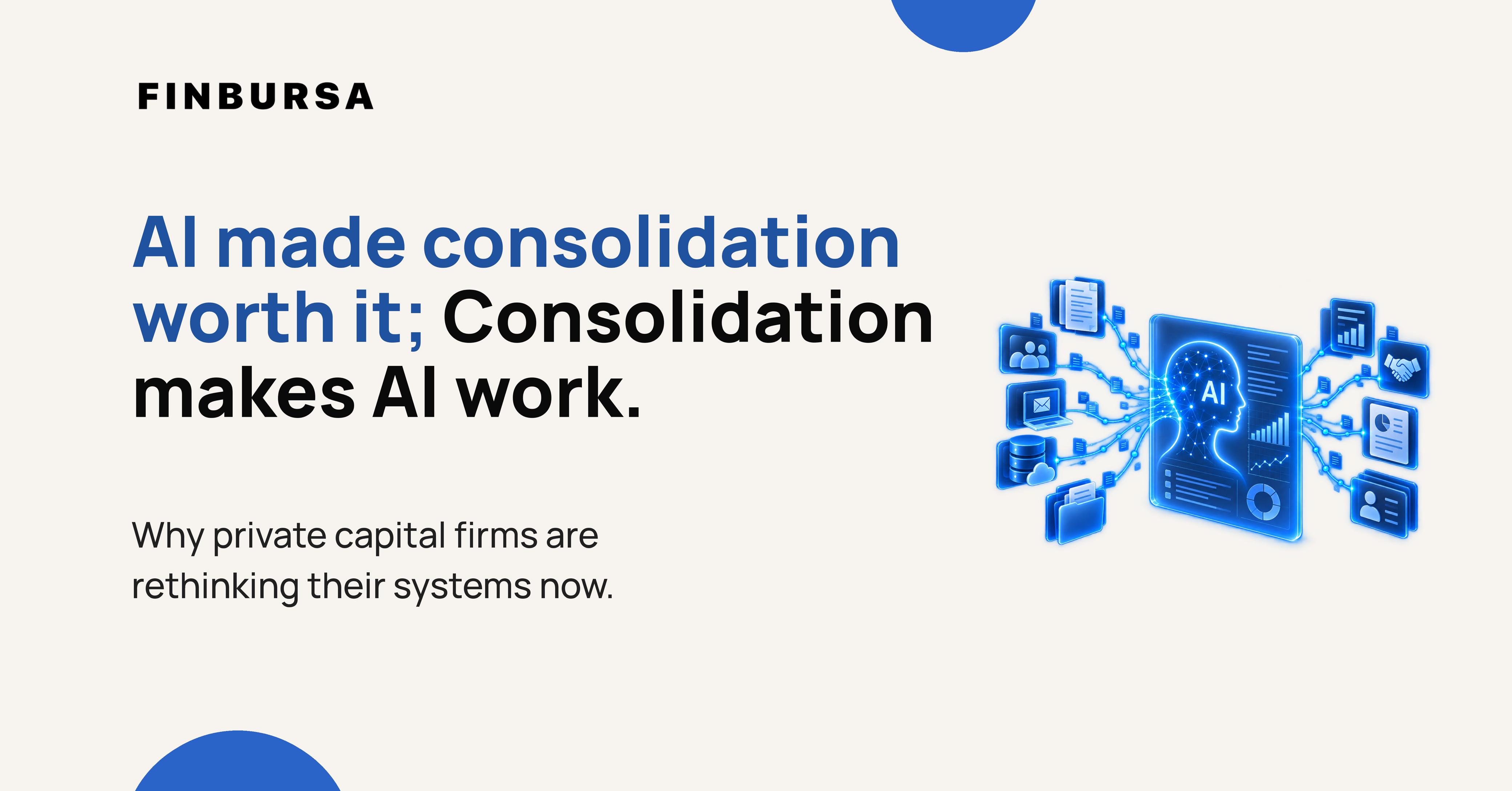
This is where AI changes the question, though not in the way it is usually sold. It will not create appetite or close a commitment. What it can do is the reading and connecting that people do not have time for. It can notice that three investors from your last fund opened the new deck and stopped at the track record. Or flag that a family office’s priorities shifted after a new chief investment officer arrived. Or suggest which twenty names, out of thousands, actually fit a mandate, and draft the follow-up a partner then edits and sends.
The catch is that AI is only as good as what it can see. Pointed at one tool, it sees one slice. To be useful in a raise, it needs the whole picture in one place: every relationship, conversation and document, with the firm’s permissions intact. That is why the order matters: connect the information first, then let AI work on it.
What firms can control
None of this changes the fundamentals. Track record, strategy, terms and trust will still matter most. But in a market where capital is concentrating, fundamentals are not always the whole story. A raise can also slip because of lost time, the right investor missed at the right moment, or a process that looks less organised than the fund next to it. For a mid-market firm, the five areas above are where a small team can make its limited time count.
Five questions worth asking before your next raise:
- If your most connected partner left tomorrow, would the firm still know which investors they knew?
- For each investor who said “not now”, do you know what would make it “now”, and roughly when?
- Could you name the forty investors who best fit this mandate, and say why each one fits?
- For every investor in your pipeline, can you say what they are waiting for?
- What would an investor say about how easy you are to evaluate?
Private capital will remain a relationship business. The firms likely to do best in the years ahead are those that run those relationships as carefully as they run their portfolios.
FinBursa builds front-office software for private markets firms.
Sources
- Fundraising timelines and share of funds closing at or above target (H1 2026): Paul, Weiss, Private Equity Fundraising at a Glance, Q2 2026
- Concentration of capital in the largest funds (Q1 2026): PitchBook Q1 2026 Global Private Market Fundraising Report, via Yahoo Finance
- LP allocation plans (survey of 300 LPs, January 2026): McKinsey, Global Private Markets Report 2026
- GP dissatisfaction with LP allocation data (February 2026 survey): S&P Global Market Intelligence, 2026 Private Equity and Venture Capital Outlook
- Public pension commitments and pacing plans (Q1 2026): Altss, US Public Pension Commitments in Q1 2026