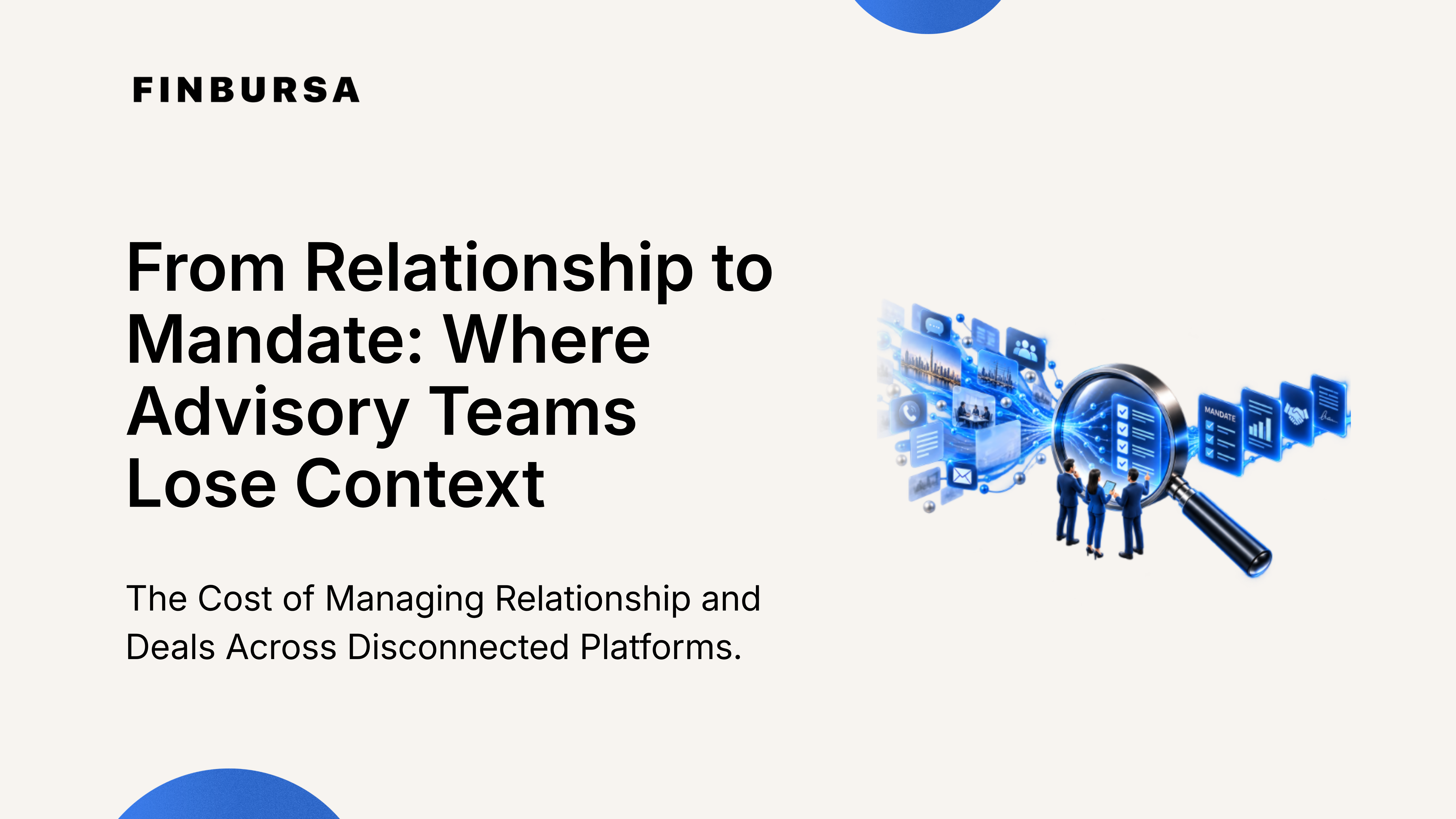
There is a moment in almost every investment process where two conversations that should be one are happening in two different places. The pipeline says an investor is in due diligence. The data room shows they have not opened a document in eleven days. Nobody on the deal team knows both things at the same time.
 |
This is the gap that real-time data connectivity closes. Pipeline management and due diligence are not sequential phases separated by a handoff. They are parallel and interdependent processes where every action in one changes the context of the other. When those processes run on different platforms with no live connection between them, the information that matters most arrives too late to act on.
This blog examines why that gap exists, what it costs, and what becomes possible when pipeline and due diligence data are unified in a single, real-time connected platform.
"A pipeline that does not reflect what is happening in the data room is not a pipeline. It is a wish list."
Why pipeline and due diligence data are almost always disconnected
The disconnection is structural. Most investment teams assemble their workflow from tools that were not built to share data with each other. The CRM manages pipeline stages. The VDR manages document access. The investor portal handles external communication. Each tool does its job independently and generates its own data in its own format, visible only to whoever logs into that specific system.
The result is that pipeline status is updated manually, based on whatever the deal team member remembers or reported at the last meeting. It reflects conversations, not behaviour. A counterparty can be marked as active in the pipeline while having disengaged entirely in the data room weeks earlier. By the time the discrepancy surfaces, the opportunity to intervene has usually passed.
This is one dimension of the broader fragmentation problem we explored in our analysis of the ROI of vendor consolidation. The cost of disconnected tools is not just financial. It is the decision quality that suffers when the data informing each decision is incomplete, delayed, or held in a system nobody checked before the meeting.
Why pipeline and due diligence data are almost always disconnected
The disconnection is structural. Most investment teams assemble their workflow from tools that were not built to share data with each other. The CRM manages pipeline stages. The VDR manages document access. The investor portal handles external communication. Each tool does its job independently and generates its own data in its own format, visible only to whoever logs into that specific system.
The result is that pipeline status is updated manually, based on whatever the deal team member remembers or reported at the last meeting. It reflects conversations, not behaviour. A counterparty can be marked as active in the pipeline while having disengaged entirely in the data room weeks earlier. By the time the discrepancy surfaces, the opportunity to intervene has usually passed.
This is one dimension of the broader fragmentation problem we explored in our analysis of the ROI of vendor consolidation. The cost of disconnected tools is not just financial. It is the decision quality that suffers when the data informing each decision is incomplete, delayed, or held in a system nobody checked before the meeting.
What real-time data connectivity actually changes
When pipeline and due diligence data share a live, connected data model, the nature of deal management changes. Pipeline stages reflect actual engagement, not reported progress. Every document access event, every return visit to a key document, every portal question submitted, updates the deal record in real time without any manual intervention from the team.
Insight 01
Pipeline stages that reflect reality
When VDR activity feeds directly into the pipeline record, stage progression is grounded in evidence rather than assumption. A counterparty who has spent significant time across multiple documents in the data room is genuinely in active diligence. One who has not opened the room in two weeks is not, regardless of what the pipeline stage says. Real-time connectivity makes that distinction automatic and visible to the entire deal team simultaneously.
Insight 02
Follow-up timing driven by data, not calendars
The most common source of missed opportunities in investment deal flow is generic follow-up on a calendar schedule that has no relationship to what the counterparty is actually doing. When pipeline data includes live diligence signals, follow-up becomes event-driven. An investor who just returned to the financial model for the third time this week is ready for a specific, targeted conversation. That conversation should happen now, not on the next scheduled check-in date.
Insight 03
Complete deal context for every team member
In fragmented stacks, deal context is distributed across team members who each access different systems. The partner who manages the investor relationship knows the CRM. The analyst running diligence knows the VDR. Neither has the complete picture without a manual briefing. On a connected platform, every team member sees the full deal record, pipeline position, diligence status, and engagement history in one view, without a meeting to synchronise.
Insight 04
AI intelligence that spans both data streams
AI-assisted deal workflows that can surface signals across both pipeline and diligence data, identifying which counterparties are most engaged, which deals are accelerating, and which are at risk of going cold, require a connected data model to function. When the pipeline and the VDR share data, AI agents can operate across the full deal picture. When they are separate, AI operates on a fragment of it.
The connection to LP engagement
Real-time data connectivity between pipeline and due diligence is directly relevant to how investment firms track LP engagement throughout the fundraising cycle. The same principles apply: LP pipeline position should reflect actual diligence behaviour, not last week's meeting notes. Document access signals from the investor portal and data room should flow into the LP relationship record automatically, giving the fund manager a live view of where each LP actually is in their decision process.
Signs the gap between your pipeline and diligence data is already hurting you
• Pipeline stage updates happen at team meetings rather than automatically when diligence activity occurs.
• A counterparty can be marked as active in your CRM while having not opened the data room in weeks.
• Follow-up timing is based on scheduled check-ins rather than triggered by engagement signals.
• Different team members have different views of deal status because they access different systems.
• You have missed a timely intervention because the diligence signal reached the wrong person too late.
• AI tools evaluated for deal intelligence cannot access both pipeline and VDR data in the same query.
• Preparing for an investor call requires checking the CRM and the VDR separately before every meeting.
The Verdict
Pipeline data and due diligence data are not two separate records about the same deal. They are two perspectives on the same reality. When they are held in separate systems and updated manually, the reality they describe is always slightly out of date. The deal team is always working with yesterday's picture of today's situation.
Real-time connectivity between pipeline and due diligence does not add complexity to the deal workflow. It removes it. Fewer systems to check before a meeting. Fewer manual updates to trigger after a counterparty interaction. Fewer moments where the wrong follow-up goes out because the right signal arrived in the wrong system at the wrong time.
The bridge between pipeline and due diligence is not a technical problem. It is a platform decision. And for investment teams managing live deal flow in competitive markets, it is one of the highest-value decisions available.
FAQs
What is real-time deal data and why does it matter in investment management?
Real-time deal data in investment management refers to live, continuously updated information about deal activity across the pipeline and due diligence process, including document access events in the VDR, investor portal interactions, pipeline stage changes, and counterparty engagement signals. It matters because investment decisions are time-sensitive and the gap between what is happening in a deal and what the team knows about it directly affects response quality and deal outcomes. Platforms that connect pipeline and diligence data in real time eliminate this gap and give deal teams a complete, current view of every active opportunity.
How should investment pipeline management and due diligence be connected?
Investment pipeline management and due diligence should be connected through a unified platform where CRM pipeline records, VDR document access activity, and investor portal interactions share a single data model. This means pipeline stage progression is informed by actual diligence behaviour rather than manual updates, follow-up timing is triggered by engagement signals rather than calendar reminders, and every team member has the same complete view of deal status without accessing multiple systems. Purpose-built investment platforms achieve this natively; general-purpose CRMs with bolt-on VDR tools cannot.
What due diligence signals should update the investment pipeline automatically?
The due diligence signals that should automatically update the investment pipeline include: first data room access by a new counterparty, return visits to specific documents such as financial models and legal terms, time spent per document session, questions submitted through the investor portal, introduction of a co-investor or advisor to the deal room, and changes in engagement frequency. When these signals flow into the pipeline record in real time, deal teams can identify which counterparties are actively progressing and which require targeted re-engagement, without manual review of multiple systems.
Can AI improve deal flow management by connecting pipeline and diligence data?
Yes. AI-assisted deal flow management is significantly more effective when pipeline and diligence data share a connected data model. AI agents operating across both data streams can identify engagement patterns that indicate commitment likelihood, surface counterparties whose diligence behaviour suggests the pipeline stage should be updated, recommend optimal follow-up timing based on document access signals, and flag deals at risk of going cold before the deal team is aware. These capabilities are not available when pipeline and VDR data are held in separate, disconnected systems.
What is the difference between a deal pipeline and a due diligence workflow?
A deal pipeline tracks the overall progression of an investment opportunity from origination through to close, including counterparty status, stage, and relationship context. A due diligence workflow manages the detailed investigation process within a specific deal, including document sharing, access control, question handling, and audit trail. In fragmented stacks these are managed separately. In a purpose-built investment platform they are connected, so pipeline status reflects diligence progress automatically and the full deal context is visible in one record.