For years, the default answer for investment firms evaluating deal management software was a single-function deal platform: purpose-built for financial services, better than a generic CRM, and capable enough for the deal volume of the time. That context matters, because the shift happening now is not about any individual platform failing. It is about a whole architectural model being overtaken by something more capable.
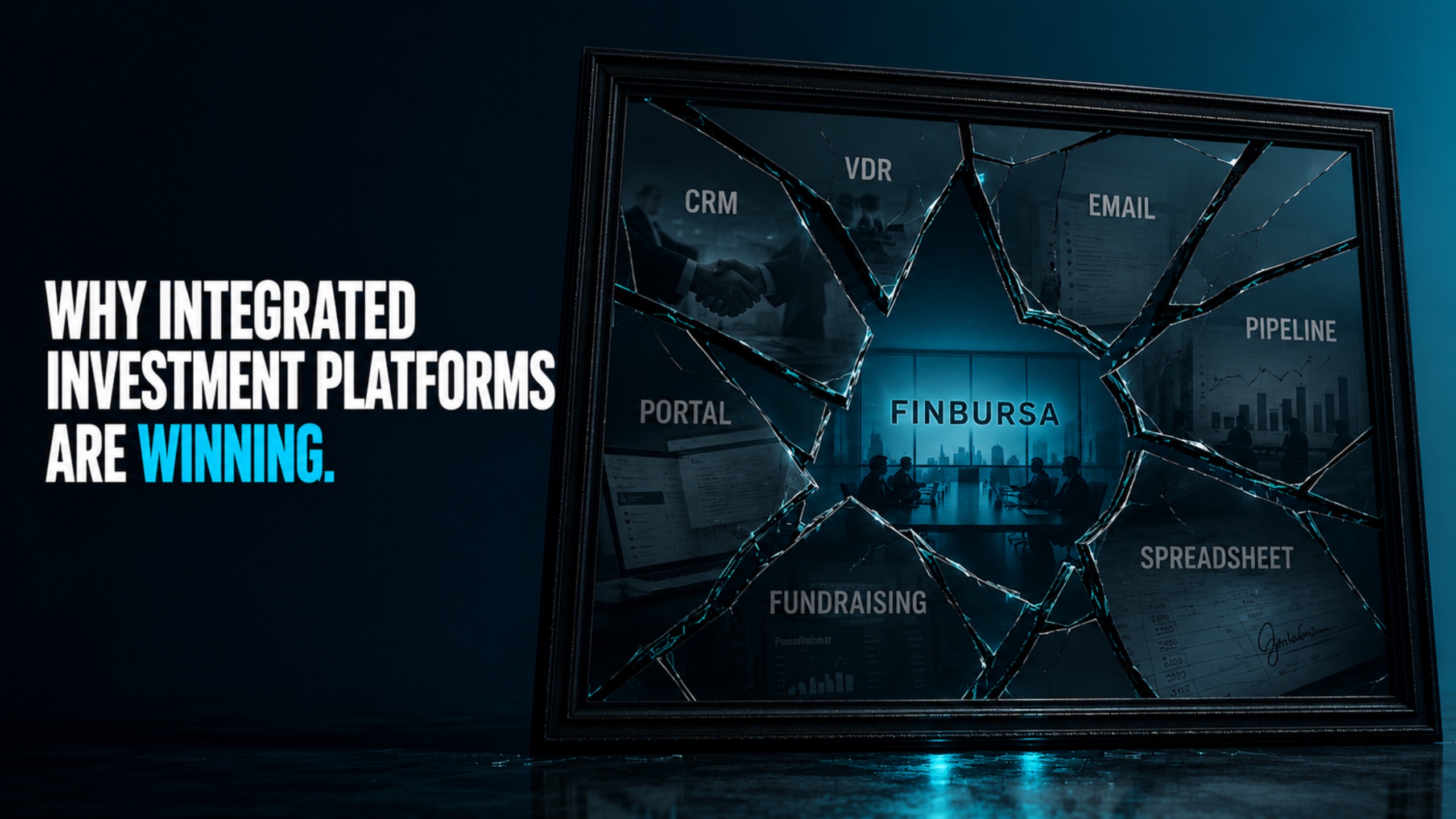 |
Single-function deal platforms, however well designed for their specific role, are built on an assumption that deal management is a discrete function. It is not. It is inseparable from investor relationship management, from the virtual data room where due diligence is conducted, from the investor portal where external parties engage, from the fundraising campaign workflow that moves LPs from interest to commitment. When these functions are connected in a single platform, the output is qualitatively different from what any combination of separate tools can produce.
This is why integrated tools are winning. Not on features. On architecture.
"The question is no longer which deal platform is best. It is whether a deal platform alone is still enough."
What single-function platforms do well and where they stop
To be precise about what is changing, it helps to be clear about what single-function deal platforms genuinely do well. Pipeline tracking, contact management within the deal context, basic activity logging, and reporting on deal status are all functions that mature deal platforms handle competently. For firms running a modest deal volume with a small team and no expectation of AI capability, this may still be sufficient.
The limitations emerge as volume grows, as investor relationships become more complex, and as the expectation of real-time deal intelligence rises. A deal platform that manages pipeline but cannot see what is happening in the data room is working with half the picture. A deal platform that tracks investor contacts but cannot map those contacts to document engagement, portal activity, or fundraising campaign status is generating relationship data that is structurally incomplete. And a deal platform that cannot share its data natively with the tools around it is, by definition, the centre of a fragmentation problem.
This is the operational cost we examined in depth in our analysis of real-time data as the bridge between pipeline and due diligence. The core finding is consistent: when pipeline data and diligence data are held in separate systems, deal teams are always working with a picture that is slightly behind the reality of the deal.
The four reasons integrated platforms are outperforming point solutions
The competitive advantage of integrated investment platforms over single-function tools is not a matter of individual features. It is a matter of what becomes possible when the entire deal workflow shares one connected data model.
Reason 01
The data model is built for investment, not adapted for it
A platform built from the ground up around investment workflows has a data model that reflects how deals actually work: multi-party relationships, staged progression, document-level engagement, investor mandate fit, and campaign-based outreach. A single-function deal platform adapted from a sales CRM, or extended through integrations, is always working around the limitations of its original architecture. The difference shows in every workflow that does not quite fit the tool.
Reason 02
Every function informs every other function in real time
When CRM, VDR, investor portal, deal rooms, and fundraising campaign workflow operate as one system, actions in any one of them update the others automatically. An investor accessing the data room updates their pipeline record. A fundraising campaign interaction updates the investor relationship history. A deal room question updates the due diligence log. None of this requires manual intervention. On a platform assembled from separate tools, all of it does.
Reason 03
Team scalability without proportional complexity
Single-function platforms scale in volume but not in complexity. As the number of active deals, investors, and team members grows, the number of manual synchronisation tasks grows proportionally. Integrated platforms scale differently: the platform holds the context, so the team does not have to. A new team member joining a deal in progress has access to the complete picture immediately, without a briefing from every person who touched a different system.
Reason 04
AI capability that requires connected data to exist
AI deal agents that match opportunities to investor appetite, surface engagement signals from VDR activity, forecast pipeline progression, and assist with fundraising campaign targeting all require a connected data model to function. This is not a capability that can be added to a fragmented stack by subscribing to an AI tool. The intelligence is only as good as the data it operates on. Integrated platforms do not just enable AI. They are the prerequisite for it.
Single-function platforms vs integrated investment platforms
| Capability | Single-Function Platforms | Integrated Investment Platform |
| Deal pipeline management | Core capability | Core capability, connected to all modules |
| VDR integration | Separate tool or add-on | Native, updates CRM in real time |
| Investor portal | Not included | Built-in, connected to deal records |
| Fundraising campaign tools | Not included | Integrated workflow module |
| LP engagement tracking | Manual CRM updates only | Automatic from portal and VDR signals |
| Due diligence workflow | Separate platform required | Native, connected to pipeline stages |
| AI deal assistance | Blocked by fragmented data | Investment-specific AI agents |
| Audit trail | Platform activity only | Full multi-system, multi-party audit |
| Investor marketplace access | Not available | Reverse inquiry and deal discovery |
| Onboarding time | Weeks per tool, multiple tools | One system, one onboarding process |
The consolidation case: what firms are actually saving
The move from a single-function deal platform to an integrated investment platform is not only an operational upgrade. It is a financial one. The combined cost of a standalone deal platform, a separate VDR subscription, a third-party investor portal, and the manual administration required to hold them together is, in most cases, materially higher than the cost of a single integrated platform covering all of these functions.
Beyond licensing costs, the recovered staff time from eliminated manual synchronisation, the deal velocity improvement from connected workflows, and the investor relationship gains from complete CRM context together produce a measurable return that compounds with every deal cycle.
Signs your current deal platform architecture has reached its ceiling
• Your deal team accesses two or more platforms before they have a complete picture of any single active deal.
• Pipeline stage updates are manual because the platform cannot see what is happening in the data room.
• Investor relationship history and document engagement live in different systems with no connection between them.
• AI tools evaluated for deal workflow automation were rejected because the underlying data was too fragmented.
• Onboarding a new team member to a live deal requires briefings from multiple people who each manage a different system.
• Your VDR is a standalone subscription that resets with every new deal rather than accumulating relationship intelligence.
• Fundraising campaign follow-up is based on calendar logic rather than live engagement signals from the investor portal.
• Reporting on deal pipeline, investor activity, and diligence status requires pulling data from three or more source.
The Verdict
The era of single-function deal platforms is not ending because they are bad at what they do. It is ending because what they do is no longer enough. The investment firms raising faster, closing more consistently, and retaining stronger investor relationships are not doing so because they found a better deal CRM. They are doing so because they made a different architectural decision: one platform, one data model, every deal function connected.
Single-function deal platforms will continue to serve firms whose workflows fit their model. But the firms setting the pace in private markets in 2026 are not asking which deal platform is best. They are asking which investment platform gives them the complete picture of every deal, every investor, and every opportunity, in real time, with AI that can act on all of it.
That is a question that only an integrated platform can answer.
FAQs
What should private equity and M&A firms look for in a deal management platform?
Private equity and M&A firms should look for a deal management platform that natively integrates deal flow management, investor CRM, virtual data room, investor portal, fundraising campaign workflow, and AI-assisted deal agents in a single connected system. The key differentiator from single-function platforms is that all deal workflow functions share one data model, which enables real-time pipeline intelligence, AI capability, and team scalability without proportional increases in manual administration. Firms should prioritise platforms where VDR activity, investor portal engagement, and pipeline stages share a connected data model rather than requiring manual synchronisation between tools.
What is an integrated investment platform and how is it different from a deal CRM?
An integrated investment platform combines every function of the investment deal workflow in a single connected system: deal flow management, investor CRM, virtual data room, fundraising campaign tools, investor portal, deal rooms, and AI-assisted deal agents. A deal CRM manages pipeline and contact records for investment transactions but does not include native VDR, investor portal, or fundraising campaign capability. The critical difference is the data model: on an integrated platform, document access events, investor portal interactions, and campaign signals automatically update the deal and investor records in real time. On a deal CRM, this data either does not exist or requires manual entry.
Why are investment firms moving away from single-function deal platforms?
Investment firms are moving away from single-function deal platforms for four reasons. First, single-function platforms cannot provide real-time deal intelligence because they only see a fraction of deal activity. Second, they require manual administration to synchronise with the VDR, investor portal, and fundraising tools that sit alongside them. Third, the combined cost of a deal platform plus the additional tools required to complete the workflow is typically higher than a single integrated platform covering all functions. Fourth, AI-assisted deal workflow capabilities require a connected data model that single-function platforms cannot provide regardless of what AI tools are added on top.
What should fund managers look for in a deal management platform in 2026?
In 2026, fund managers should look for a deal management platform that natively integrates investment CRM, deal flow management with customisable pre-investment stages, virtual data room with multi-level permissions and audit trail, investor portal for external deal room and document access, fundraising and sales campaign workflow, AI-assisted deal matching and engagement analysis, and access to a broader investment marketplace. The critical test is whether these functions share a connected data model where VDR activity updates the CRM record in real time, or whether they operate as separate modules requiring manual synchronisation between them.
How does AI work differently on an integrated investment platform vs a deal CRM?
On an integrated investment platform, AI agents operate across the complete deal data set: pipeline status, investor relationship history, VDR document engagement, investor portal interactions, and fundraising campaign signals. This means AI can match opportunities to investor appetite based on historical behaviour, surface engagement signals that indicate commitment likelihood, recommend optimal follow-up timing, and identify deals at risk of going cold. On a single-function deal CRM, AI operates only on pipeline and contact data, which is a fraction of the relevant information. The AI is only as useful as the data it can access, and on a fragmented stack, that data is always incomplete.