The hidden cost of per-deal virtual data room pricing
Somewhere today, an investment banker is opening another virtual data room. Not because the transaction is unusually complex. Not because the client requested extra security. Simply because another mandate has landed on the desk.
The room will need to be configured. Permissions assigned. Documents uploaded. Branding applied. Legal will review the access settings. Buyers will be invited. The invoice will arrive shortly after.
Next month, the process begins again.
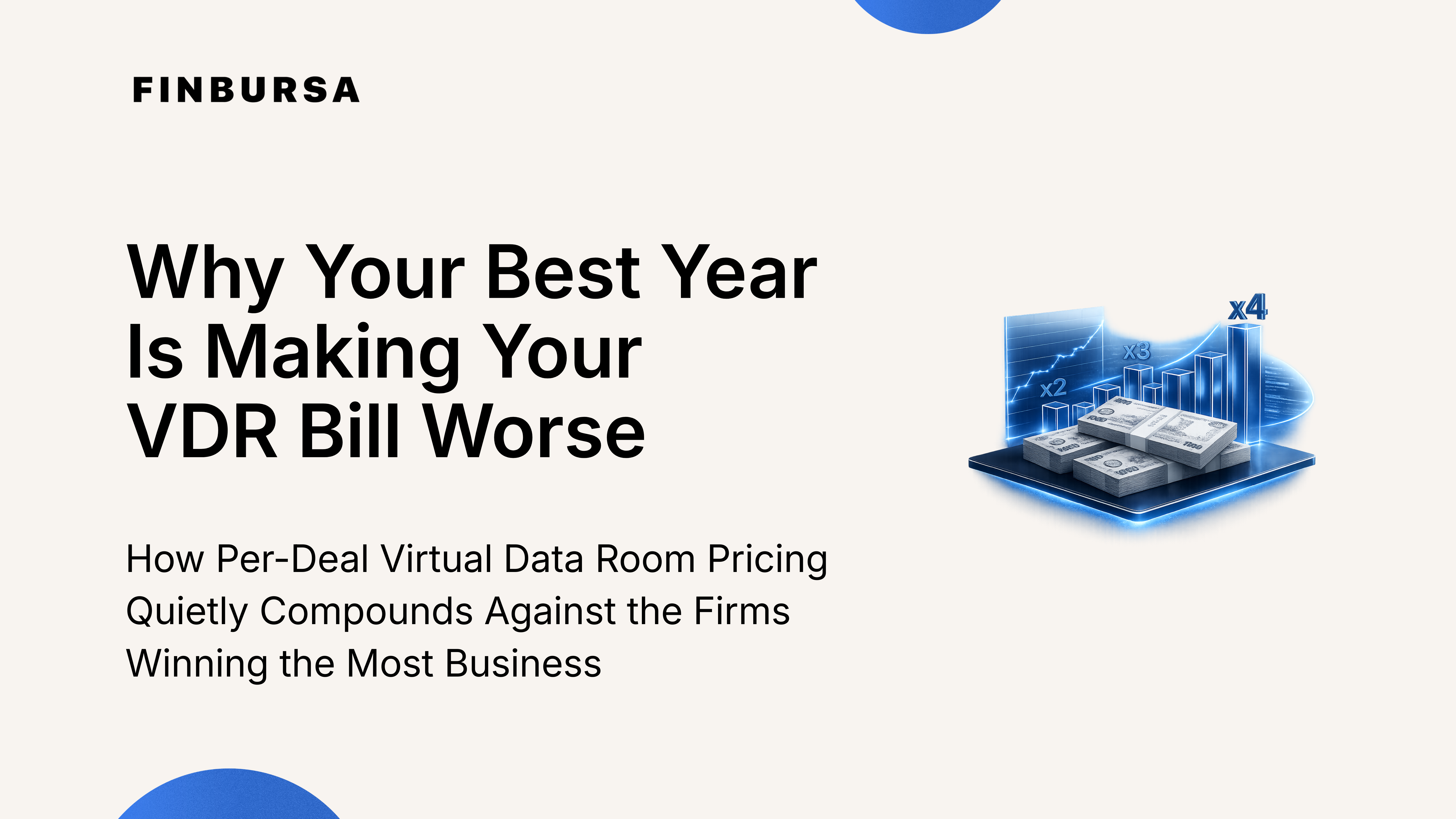
Per-deal VDR pricing commonly runs into the low-to-mid five figures per room once setup, seats, storage, and an extended diligence timeline are factored in, and a single deal often needs two or three rooms across its lifecycle, not one. These are illustrative, order-of magnitude figures that vary by vendor and deal complexity. Multiply that across a real deal book, and a pattern most firms never total up starts to show itself: the firms winning the most business are often the firms paying the most for the exact same technology.
That is a strange way to scale a business.
 |
How Per-Deal VDR Pricing Compounds
Per-deal pricing was built for a world where firms ran one transaction at a time. That is no longer how private markets operate, and the math compounds differently depending on the type of firm running it.
An advisory boutique running eight mandates a year, with two to three rooms per mandate as buyers and lenders require separate, permissioned access, is standing up somewhere between sixteen and twenty-four data room instances annually, before a single fee is negotiated.
A private equity firm closing five platform deals a year pays the per-deal fee five times, once per transaction, with no discount for the fifth room simply because it is the fifth.
A private credit fund carries a different shape of the same problem: a lending book of forty or fifty facilities, each one needing a room for underwriting and, increasingly, an ongoing repository for the covenant and financial-statement submissions that follow it for years after close.
A real assets manager running a multi-year acquisition pipeline pays per asset, and a single18-month acquisition can require its own room stood up long before the deal is public.
Every vertical hits the same wall from a different direction: the software scales with the number of deals, not with the size of the firm. A stronger year, a busier pipeline, a couple of live processes running in parallel: the cost stack scales in lockstep with the firm's best quarters, which is exactly when nobody wants to be negotiating a vendor invoice.
Add it up for a firm running a typical multi-deal book across a year, and the illustrative total lands in the low-to-mid six figures in VDR fees alone, before the CRM, the pipeline tool, coordination hours underneath it are counted at all.
Related reading: The Real Cost of Running M&A Mandates breaks this same math down mandate by mandate for advisory firms specifically
The Behavioral Cost: What Firms Do to Avoid Paying It
The pricing model does not just cost money. It changes behavior, and the behavior it produces is its own quiet source of risk.
Firms ration data rooms rather than opening a clean one per counterparty, reusing a single room across buyers who should have been kept separate. Deal teams delay standing up a room until diligence is imminent, instead of having a controlled environment ready from first contact. Some processes get run in email for longer than they should, specifically to avoid the procurement step, with the data room brought in only once a deal looks serious enough to justify the fee.
None of this is a firm behaving carelessly. It is a rational response to a pricing model that punishes exactly the behavior (opening a room early, keeping counterparties cleanly separated, treating every deal with the same rigor regardless of size) that good process actually requires.
The Real Expense Is Rarely the Invoice
The license fee is the part everyone notices. The larger cost rarely appears on it.
Every new room needs someone to configure permissions, recreate folder structures, upload documents, invite counterparties, answer access requests, and monitor activity for the life of the deal. None of that produces advisory revenue. It consumes the time of the people who are supposed to be running the transaction, not administering the software underneath it.
That fragmentation compounds because the data room is rarely the only system involved. Buyer or investor relationships live in a CRM. Pipeline status lives somewhere else. Communication happens over email. Internal tracking survives in a spreadsheet. Every platform holds one piece of the deal; none of them holds the whole picture. A revised model gets uploaded to one system and not another. Someone spends half an hour confirming which counterparties have cleared NDA because the answer exists across three different tools instead of one.
What an Unlimited VDR Pricing Model Changes
Imagine opening a new mandate, deal, facility, or acquisition without a procurement step attached to it. The room already exists as part of the workflow. Permissions inherit from the deal record. Counterparty activity appears alongside every other interaction on that deal. No new vendor conversation, no new invoice, no new security review: just another matter inside infrastructure the firm already owns.
That is the difference between treating a data room as a per-transaction expense and treating it as infrastructure. Firms do not buy a new CRM every time they sign a client. There is no structural reason a data room should work differently, other than the fact that VDR pricing was built for an era when most firms ran one deal at a time.
Related reading: The Connected Front Office for Private Markets lays out the fuller operating-model argument this section gestures at: one environment across relationships, deals, documents, and reporting, not just one unlimited data room.
The Native Answer
This is the shift FinBursa is built around. Rather than pricing data rooms per deal, FinBursa includes unlimited virtual data rooms at zero marginal cost inside one white-labeled environment that also runs the firm's buyer or investor CRM, pipeline, and fundraising workflow, so every new mandate, deal, facility, or acquisition gets a room without a new procurement cycle behind it.
The mandate-level version of this argument, with the full cost stack broken out for advisory firms specifically, is in The Real Cost of Running M&A Mandates.
The associate no longer reconciles a buyer list across spreadsheets and inboxes before a bid deadline because the room's procurement was delayed. The partner no longer negotiates afresh VDR invoice every time the firm wins. The deal team spends less time managing the software underneath the transaction and more time managing the transaction itself.
Read next: The True Cost of Disconnected Tools - The Connected Front Office for Private Markets
FAQs
What does a virtual data room cost for an M&A mandate?
Per-deal VDR pricing for a midmarket mandate commonly runs into the low-to-mid five figures per room once setup, seats, storage, and an extended diligence timeline are included, and a single mandate often requires two or three rooms across its lifecycle.
What is the best VDR for M&A advisory firms?
The right choice depends on deal volume. Firms running a handful of mandates a year may find per-deal pricing manageable; firms running five to ten simultaneous mandates typically reach a point where unlimited, subscription-based data rooms materially change the mandate's economics.
How do advisory firms manage NDA and bid-round coordination without email?
A connected mandate pipeline tracks NDA status, staged document access, and bid deadlines against each buyer automatically, with an immutable audit trail replacing manual inbox reconciliation.
Do regulators require a virtual data room for M&A due diligence?
No U.S. regulator explicitly mandates the use of a virtual data room. However, regulatory expectations around auditable access and controlled disclosure of sensitive information, including the DOJ's 2025 Bulk Data Rule and FTC guidance on pre-merger due diligence, have made controlled data rooms the accepted market standard for meeting those expectations.
How is book building software different from a standard CRM?
Book building software tracks IOIs and bids across every buyer in a round simultaneously, purpose-built for the exclusivity and bid-deadline mechanics of an M&A process — functionality a generic CRM was not designed to handle.