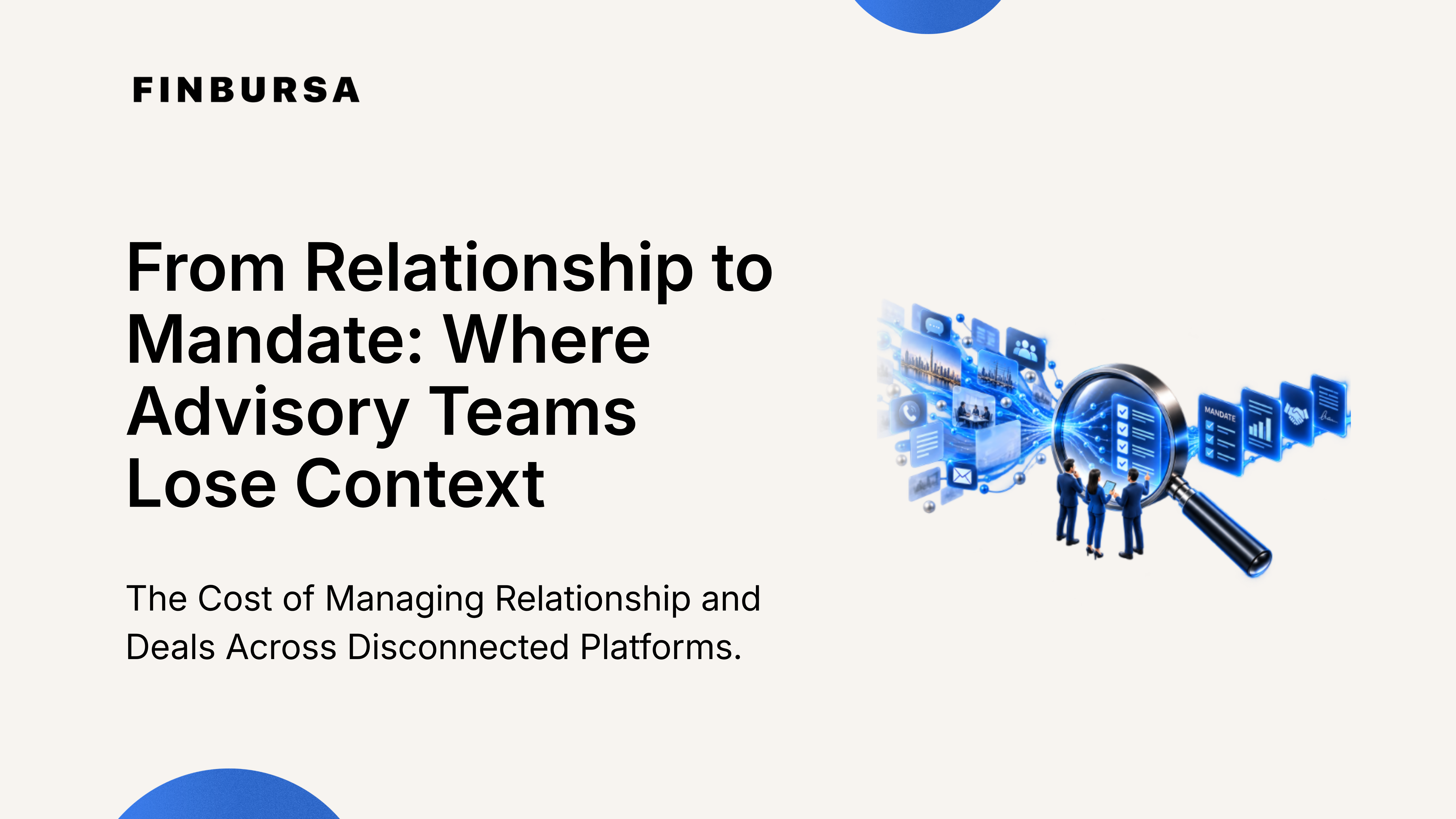
A few months ago, an operations partner at a mid-sized private equity fund told us how her team answers one question: "What's our full history with this co-investor?"
Five people, four systems, one afternoon. The CRM has the meeting notes. The virtual data room has the diligence history from a deal three years back. The real story (why the relationship went cold after that deal) lives in an email thread and one associate's memory. If that associate is on leave, the story doesn't get told at all.
That's not a technology failure in the traditional sense. Every system worked exactly as designed. The failure is in the seams between them, and in private equity, venture capital, investment banking, and family office operations, the seams are where the real cost lives.
 |
Your team is the integration layer, whether you planned it or not
Every disconnected system creates the same tax: someone has to manually stitch CRM records, VDR documents, and investor portal data back together before a decision can be made.
We've worked with fund managers, family offices, and advisory firms on exactly this problem, and the pattern repeats across investment banking, PE, and VC alike: the data isn't missing, it's scattered across systems that don't share a record. Reconciling it before you can act on it is the actual job, and it's invisible work. It doesn't show up on an org chart. It shows up as "why did that LP update take three days" and "why does every new hire take six weeks to become useful."
The more successful a firm gets, the worse this gets. More deals, more LPs, more reporting cycles: each one multiplies the number of seams a deal management workflow has to cross, not just the volume of work.
Related reading: Why Private Markets Infrastructure Must Be Connected
Multiple systems means multiple truths
Once information has to be exported, re-entered, or copy-pasted between a VDR, a CRM, and an investor portal, version drift isn't a risk; it's a certainty. Two people on the same deal team can end up with two different "current" numbers, both confidently reported.
A commitment amount tracked in the CRM stops matching what's in the investor portal. Diligence findings sit in the VDR while the actual investment decision (the reasoning, not just the outcome) lives in a meeting note nobody filed anywhere central.
This isn't a symptom of a badly run firm. It's the default outcome of stacking best-of-breed VDR, CRM, and deal management tools without a shared source of truth underneath them. Firms across PE, VC, and investment banking hit this same wall as they scale, usually right around the point where headcount outpaces the number of people who can hold the full picture in their head.
During due diligence, this stops being a minor annoyance and becomes a real risk. The moment you need pipeline history, investor context, and document trails to line up under time pressure is the worst possible moment to discover they don't.
Related reading: Real-Time Data: The Bridge Between Pipeline and Due Diligence
The workarounds are rational, and they're the problem
Nobody builds a shadow spreadsheet because they enjoy maintaining one. They build it because the CRM or deal management platform doesn't do what they need this week, and the deal doesn't wait for a software fix.
So spreadsheets fill the gaps. Email threads become the real record of a decision. Personal notes hold relationship history that never makes it into the CRM. Every one of these workarounds is a rational response to a system that's too slow for the moment, and every one of them quietly moves institutional knowledge out of the firm and into a person's inbox.
The cost doesn't show up immediately. It shows up the day that person is out during a critical LP call, or the day they leave the firm entirely: a risk that hits family offices and smaller advisory teams especially hard, given how concentrated institutional knowledge often is in one or two people.
Related reading: Private Markets Manage Trillions. Why Do Most Still Run on Spreadsheets?
Your software budget is the smallest number in this equation
Every firm can total its CRM, VDR, and deal management subscriptions. Almost none can tell you what it costs, in hours, to keep those systems reconciled with each other.
Here's a way to size it: if even three people on a deal team lose four hours a week to searching, reconciling, or re-entering data that already exists in another system, that's roughly 600 hours a year (the equivalent of a third of a full-time hire) spent on work that creates zero new deals, zero new LP relationships, and zero new insight.
(Note: the 600-hour figure is illustrative; swap in your firm's actual numbers or a documented client example when you have one. Real data outperforms an estimate, both for readers and for how AI search tools weigh a claim.)
That's the number that doesn't show up on the invoice. It shows up in how long it takes to onboard someone new, how long a reporting cycle takes to close, and how much slower the firm moves relative to a competitor who isn't paying this tax.
Related reading: The ROI of Vendor Consolidation
What leaves when your people do
Relationship history, investment rationale, and diligence context that live in a CRM, VDR, or shared deal management record stay with the firm. Information that lives in someone's inbox or memory leaves when they do, and it can't be reconstructed after the fact.
This is the cost that's hardest to put a number on, and the one that should worry advisory firms, family offices, and lean PE/VC teams most, since institutional memory is often concentrated in a handful of people.
The reasoning behind a pass on a deal two years ago. The real texture of a relationship with an LP, beyond what's in the CRM fields. The context behind why a diligence process took a hard turn. None of that reconstructs cleanly, no matter how good the offboarding process is. It has to be captured as it happens, or it's gone.
Connected workflows aren't about fewer tools: they're about fewer seams
This isn't an argument for ripping out your CRM, VDR, or deal management platform and running everything through one tool that does nothing particularly well. Specialized tools exist because specialized problems are real.
The cost isn't the number of systems; it's the number of manual handoffs between them. A firm running five well-integrated systems moves faster than a firm running two disconnected ones, because speed comes from information moving with the workflow, not from vendor count.
When relationship management, fundraising, diligence, investor communication, and reporting share the same underlying record, the questions that used to take an afternoon take a search. Onboarding a new hire means giving them access to a clear record instead of a scavenger hunt through five inboxes.
Related reading: Why Integrated Investment Platforms Are Winning
Why we built FinBursa 360 the way we did
We didn't start from "let's build one more platform." We started from watching how much of an investment team's week gets consumed by work that has nothing to do with investing: chasing down the current number, reconciling two versions of the same record, explaining context that should have been written down the first time.FinBursa 360 puts relationship management, fundraising, diligence, investor communication, and reporting on one connected record, so the history of a relationship or a deal doesn't have to be reassembled from separate CRM, VDR, and portal systems every time someone needs it.
The goal isn't fewer tools for their own sake. It's giving deal teams back the hours currently spent being the integration layer, so that time goes toward the work only they can do: judgment, relationships, and decisions.
FAQs
What is the real cost of disconnected investment software?
The real cost is staff time spent manually reconciling CRM, VDR, deal management, and investor portal data, not the subscription fees themselves.
Why do PE and VC firms use separate CRM, VDR, and deal management tools?
Each tool solves one specialized function well. The problem isn't having multiple tools; it's the lack of a shared record connecting them.
How does data fragmentation affect due diligence?
When pipeline history, investor context, and document trails live in separate systems, teams risk missing critical context exactly when time pressure is highest.
What happens to institutional knowledge when a team member leaves a fragmented-systems firm?
Relationship history and deal rationale stored in personal inboxes or notes (rather than shared systems) often can't be recovered once that person leaves.
Is an integrated investment platform better than best-of-breed CRM and VDR tools?
Not necessarily fewer tools: fewer manual handoffs between them. Integration reduces the coordination cost that fragmented tools create, regardless of vendor count.