The hidden cost of per-deal virtual data room pricing
Somewhere today, an investment banker is opening another virtual data room. Not becausethe transaction is unusually complex. Not because the client requested extra security.Simply because another mandate has landed on the desk.
The room will need to be configured. Permissions assigned. Documents uploaded.Branding applied. Legal will review the access settings. Buyers will be invited. The invoicewill arrive shortly after.
Next month, the process begins again.
Per-deal VDR pricing commonly runs into the low-to-mid five figures per room once setup,seats, storage, and an extended diligence timeline are factored in, and a single deal oftenneeds two or three rooms across its lifecycle, not one. These are illustrative, order-ofmagnitude figures that vary by vendor and deal complexity. Multiply that across a real dealbook, and a pattern most firms never total up starts to show itself: the firms winning themost business are often the firms paying the most for the exact same technology.
That is a strange way to scale a business.
 |
How Per-Deal VDR Pricing Compounds
Per-deal pricing was built for a world where firms ran one transaction at a time. That is nolonger how private markets operate, and the math compounds differently depending on thetype of firm running it.
An advisory boutique running eight mandates a year, with two to three rooms per mandateas buyers and lenders require separate, permissioned access, is standing up somewherebetween sixteen and twenty-four data room instances annually, before a single fee isnegotiated.
A private equity firm closing five platform deals a year pays the per-deal fee five times, onceper transaction, with no discount for the fifth room simply because it is the fifth.
A private credit fund carries a different shape of the same problem: a lending book of fortyor fifty facilities, each one needing a room for underwriting and, increasingly, an ongoingrepository for the covenant and financial-statement submissions that follow it for yearsafter close.
A real assets manager running a multi-year acquisition pipeline pays per asset, and a single18-month acquisition can require its own room stood up long before the deal is public.
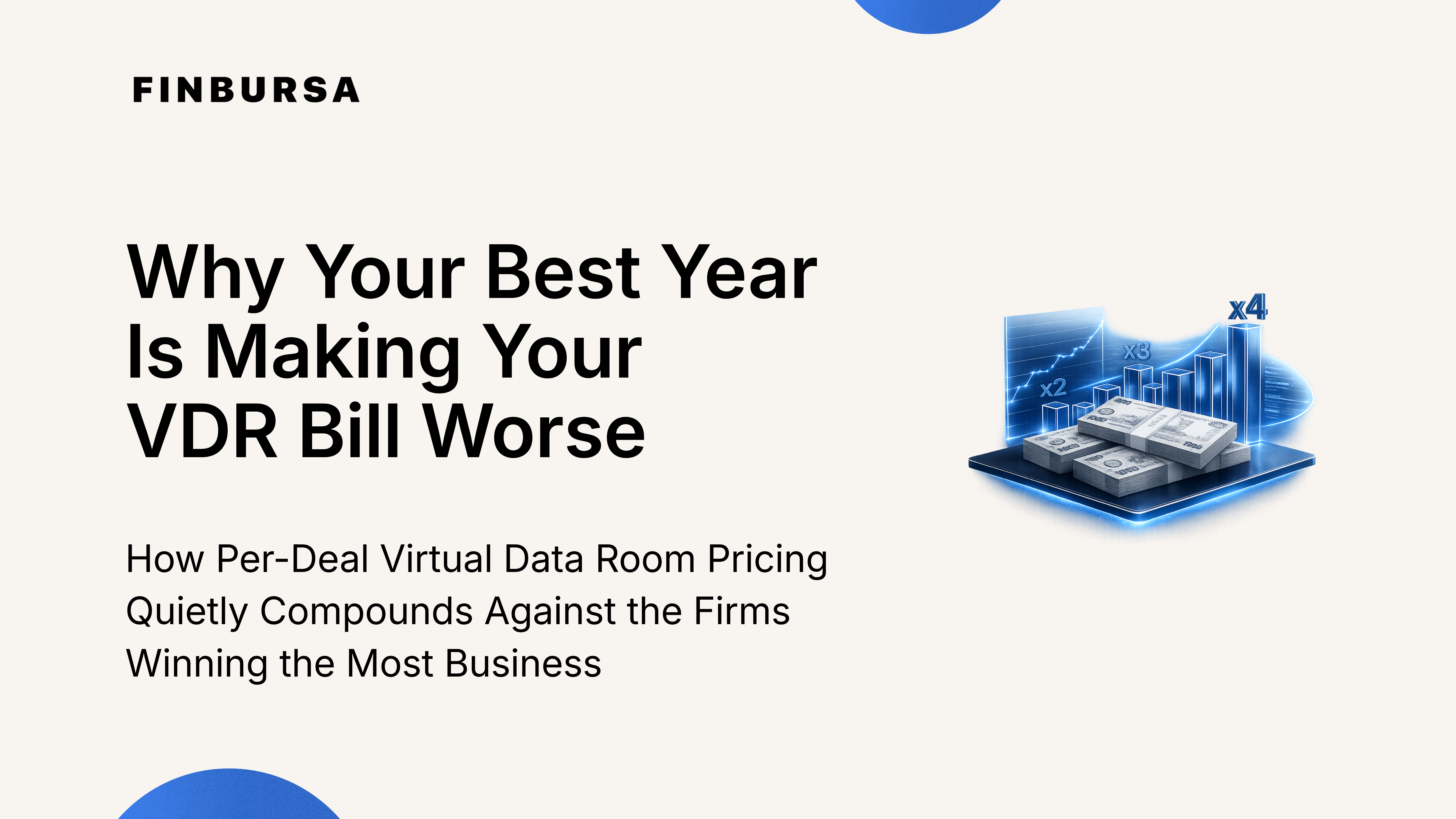
Every vertical hits the same wall from a different direction: the software scales with thenumber of deals, not with the size of the firm. A stronger year, a busier pipeline, a coupleof live processes running in parallel: the cost stack scales in lockstep with the firm's bestquarters, which is exactly when nobody wants to be negotiating a vendor invoice.
Add it up for a firm running a typical multi-deal book across a year, and the illustrative totallands in the low-to-mid six figures in VDR fees alone, before the CRM, the pipeline tool, orthe coordination hours underneath it are counted at all.
Related reading: The Real Cost of Running M&A Mandates breaks this same math downmandate by mandate for advisory firms specifically
The Behavioral Cost: What Firms Do to Avoid Paying It
The pricing model does not just cost money. It changes behavior, and the behavior itproduces is its own quiet source of risk.
Firms ration data rooms rather than opening a clean one per counterparty, reusing a singleroom across buyers who should have been kept separate. Deal teams delay standing up aroom until diligence is imminent, instead of having a controlled environment ready fromfirst contact. Some processes get run in email for longer than they should, specifically toavoid the procurement step, with the data room brought in only once a deal looks seriousenough to justify the fee.
None of this is a firm behaving carelessly. It is a rational response to a pricing model thatpunishes exactly the behavior (opening a room early, keeping counterparties cleanlyseparated, treating every deal with the same rigor regardless of size) that good processactually requires.
The Real Expense Is Rarely the Invoice
The pricing model does not just cost money. It changes behavior, and the behavior itproduces is its own quiet source of risk.
Firms ration data rooms rather than opening a clean one per counterparty, reusing a singleroom across buyers who should have been kept separate. Deal teams delay standing up aroom until diligence is imminent, instead of having a controlled environment ready fromfirst contact. Some processes get run in email for longer than they should, specifically toavoid the procurement step, with the data room brought in only once a deal looks seriousenough to justify the fee.
None of this is a firm behaving carelessly. It is a rational response to a pricing model thatpunishes exactly the behavior (opening a room early, keeping counterparties cleanlyseparated, treating every deal with the same rigor regardless of size) that good processactually requires.
The Real Expense Is Rarely the Invoice
The license fee is the part everyone notices. The larger cost rarely appears on it.
Every new room needs someone to configure permissions, recreate folder structures,upload documents, invite counterparties, answer access requests, and monitor activity forthe life of the deal. None of that produces advisory revenue. It consumes the time of thepeople who are supposed to be running the transaction, not administering the softwareunderneath it.
That fragmentation compounds because the data room is rarely the only system involved.Buyer or investor relationships live in a CRM. Pipeline status lives somewhere else.Communication happens over email. Internal tracking survives in a spreadsheet. Everyplatform holds one piece of the deal; none of them holds the whole picture. A revised modelgets uploaded to one system and not another. Someone spends half an hour confirmingwhich counterparties have cleared NDA because the answer exists across three differenttools instead of one.
What an Unlimited VDR Pricing Model Changes
Imagine opening a new mandate, deal, facility, or acquisition without a procurement stepattached to it. The room already exists as part of the workflow. Permissions inherit from thedeal record. Counterparty activity appears alongside every other interaction on that deal.No new vendor conversation, no new invoice, no new security review: just another matterinside infrastructure the firm already owns.
That is the difference between treating a data room as a per-transaction expense andtreating it as infrastructure. Firms do not buy a new CRM every time they sign a client.There is no structural reason a data room should work differently, other than the fact thatVDR pricing was built for an era when most firms ran one deal at a time.
Related reading: The Connected Front Office for Private Markets lays out the fulleroperating-model argument this section gestures at: one environment across relationships,deals, documents, and reporting, not just one unlimited data room.
The Native Answer
This is the shift FinBursa is built around. Rather than pricing data rooms per deal, FinBursaincludes unlimited virtual data rooms at zero marginal cost inside one white-labeledenvironment that also runs the firm's buyer or investor CRM, pipeline, and fundraisingworkflow, so every new mandate, deal, facility, or acquisition gets a room without a newprocurement cycle behind it.
The mandate-level version of this argument, with the full cost stack broken out for advisoryfirms specifically, is in The Real Cost of Running M&A Mandates.
The associate no longer reconciles a buyer list across spreadsheets and inboxes before a biddeadline because the room's procurement was delayed. The partner no longer negotiates afresh VDR invoice every time the firm wins. The deal team spends less time managing thesoftware underneath the transaction and more time managing the transaction itself.
Read next: See the InvestmentThe True Cost of Disconnected Tools · The Connected Front Office for Private Markets
FAQs
What does a virtual data room cost for an M&A mandate?
Per-deal VDR pricing for a midmarket mandate commonly runs into the low-to-mid five figures per room once setup, seats, storage, and an extended diligence timeline are included, and a single mandate often requires two or three rooms across its lifecycle.
What is the best VDR for M&A advisory firms?
The right choice depends on deal volume. Firms running a handful of mandates a year may find per-deal pricing manageable; firms running five to ten simultaneous mandates typically reach a point where unlimited, subscription-based data rooms materially change the mandate's economics.
How do advisory firms manage NDA and bid-round coordination without email?
A connected mandate pipeline tracks NDA status, staged document access, and bid deadlines against each buyer automatically, with an immutable audit trail replacing manual inbox reconciliation.
Do regulators require a virtual data room for M&A due diligence?
No U.S. regulator explicitly mandates the use of a virtual data room. However, regulatory expectations around auditable access and controlled disclosure of sensitive information, including the DOJ's 2025 Bulk Data Rule and FTC guidance on pre-merger due diligence, have made controlled data rooms the accepted market standard for meeting those expectations.
How is bookbuilding software different from a standard CRM?
Bookbuilding software tracks IOIs and bids across every buyer in a round simultaneously, purpose-built for the exclusivity and bid-deadline mechanics of an M&A process — functionality a generic CRM was not designed to handle.